
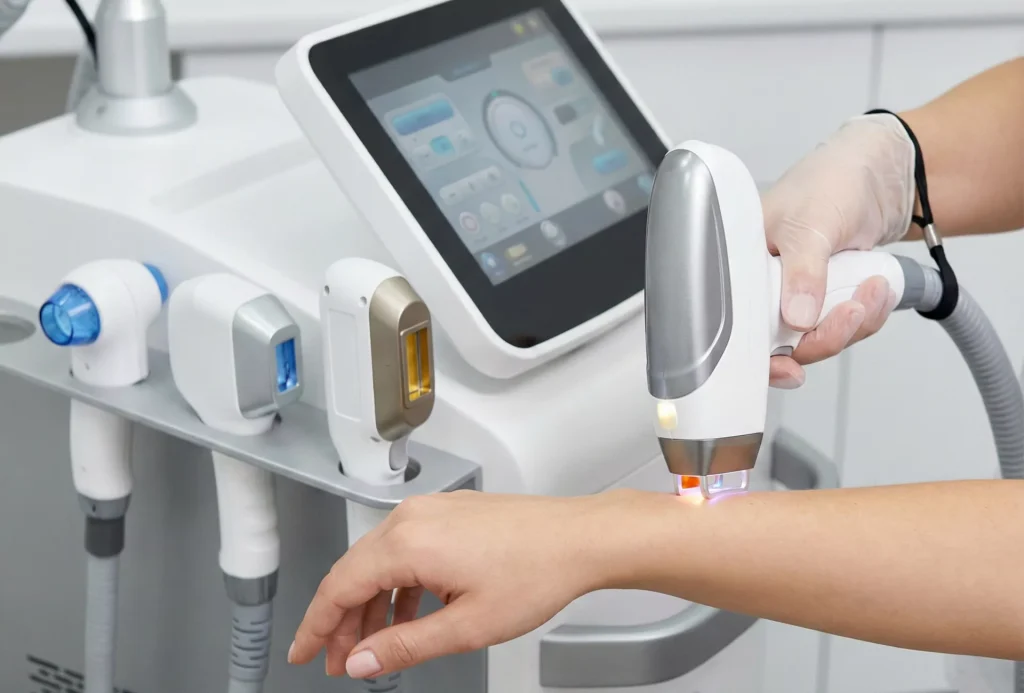
Choosing the correct laser wavelength is the most crucial step in professional hair removal (LHR) for achieving efficacy and ensuring safety. This decision must be based entirely on your unique skin tone and hair color. Misalignment between laser technology and your skin type can lead to poor results or complications like burns and permanent pigment changes. This definitive guide simplifies the science of Diode, Alexandrite, and Nd:YAG lasers to help you find your ideal match.
Key Takeaways
The laser hair removal wavelength must match your skin type for safe and effective results:
- 755 nm Alexandrite: Best for light skin (Fitzpatrick I–III). High efficacy, but high risk for dark skin.
- 810 nm Diode: Versatile choice for a broad range of skin types (I–IV), especially with advanced cooling.
- 1064 nm Nd:YAG: Safest and preferred choice for dark skin (Fitzpatrick V–VI), as it penetrates deeper with minimal risk of surface damage.
- Safety First: Always ask your provider which laser they will use and why. Insist on a patch test.
What is Laser Hair Removal (Quick Overview)
Before diving into wavelengths, here is a concise explanation of how laser hair removal works and why matching the device to your characteristics is vital.
LHR uses selective photothermolysis, where light targets a specific pigment (melanin) in the hair follicle. The light is converted to heat, damaging the follicle cells and preventing future growth.
- Melanin Targeting: Laser energy is absorbed by the hair’s pigment, generating heat to destroy the follicle.
- The Session Cycle: Multiple sessions are required (typically 3–6+) because the laser only targets hair in the active growth (Anagen) phase.
- Risk/Reward: Melanin exists in both the hair (target) and the epidermis (skin). On darker skin, shorter wavelengths are absorbed too quickly by the surface, leading to a high risk of damage like hyperpigmentation. Wavelength matching eliminates this risk.
What Each Wavelength Means (755 nm vs 810 nm vs 1064 nm)
The wavelength (measured in nanometers, nm) dictates how deeply the laser light penetrates and how intensely it is absorbed by melanin. Shorter wavelengths stay superficial; longer wavelengths penetrate deeper with less surface absorption.
755 nm Alexandrite, Fast for Lighter Skin (I–III)
The Alexandrite laser operates at 755 nm, offering the highest melanin absorption rate.
- Strengths and Limits: Highly effective for targeting pigment in the hair shaft, allowing for quick treatments. It is best on light skin types (I–III) with dark hair.
- Caution: Due to its high absorption, 755 nm carries a significant risk of burns and pigment changes when used on tanned or darker skin (Type IV+).
810 nm Diode, Versatile Across Many Skin Types
The Diode laser, typically at 810 nm, offers a versatile balance between melanin absorption and penetration depth, making it the most common platform globally.
- Broad Use: With proper settings (long pulse duration) and strong cooling, it is effective across a wider range, particularly Fitzpatrick Types I–IV.
- Comfort Note: Many modern diode systems use a gentler “sweep” technique, often enhancing patient comfort.
1064 nm Nd:YAG — Safest Choice for Darker Skin (IV–VI)
The Nd:YAG laser operates at 1064 nm, offering the greatest depth and safety for pigmented skin.
- Deeper Penetration & Safety: It has the lowest epidermal melanin absorption, allowing the light to bypass the surface skin and target the deep hair bulb.
- Preferred for Skin of Colour: The 1064 nm Nd:YAG laser is the preferred and safest choice for darker skin tones (Types V and VI).
Fitzpatrick Skin Types & Why They Matter
The Fitzpatrick scale (Types I to VI) classifies skin’s reaction to light. High epidermal melanin (darker skin) requires longer wavelengths to prevent surface injury and post-inflammatory hyperpigmentation (PIH).
Mapping Laser to Skin Type (I–VI)
| Fitzpatrick Skin Type | Skin Characteristics | Primary Wavelength Recommendation |
| I–III | Pale, easily burns, or light beige, mild burning. | 755 nm Alexandrite (Fastest and most effective) or 810 nm Diode. |
| IV | Moderate brown, rarely burns, tans easily. | 810 nm Diode (with cooling) or cautious 1064 nm Nd:YAG. Alexandrite used only with extreme caution and test patches. |
| V–VI | Dark brown to black, rarely/never burns. | 1064 nm Nd:YAG (Long-pulsed) is highly preferred for safety. |
For Type IV and higher, the safety profile of the Nd:YAG is often considered non-negotiable due to its lower risk of causing post-inflammatory hyperpigmentation (PIH), the darkening of the skin that commonly occurs after thermal injury.
Cooling, Pulse Duration & Spot Size Basics
Optimal treatment requires adjusting three critical parameters beyond wavelength selection:
- Epidermal Protection (Cooling): Methods like contact cooling or cryogen spray are used to instantly cool the skin surface, protecting the epidermis while the heat reaches the deeper follicle.
- Pulse Duration (ms): Longer pulse widths are crucial for darker skin to allow the energy to dissipate more slowly, preventing sudden heat spikes that cause damage.
- Spot Size (mm): Larger spot sizes facilitate deeper penetration and more uniform heating, improving efficiency, especially on large body areas.
Hair Variables: How Color and Depth Impact Wavelength Choice
Hair characteristics are the final variable determining laser efficiency. Hair color dictates the target size, and depth dictates the required penetration, influencing the choice among 755 nm, 810 nm, and 1064 nm lasers.
Dark Coarse Hair vs Fine/Light Hair
- Dark Coarse Hair: Contains the highest melanin concentration, making it the ideal target for all three laser types (if skin-matched).
- Fine/Light Hair: Lasers are generally ineffective for blonde, red, grey, or white hair due to insufficient melanin. Electrolysis should be considered instead.
Follicle Depth & Why 1064 nm Reaches Deeper
- Depth Implications: Follicles on the back are deeper than those on the face.
- Nd:YAG’s Advantage: The 1064 nm Nd:YAG offers the deepest penetration among the three, making it effective for deeply rooted hairs where shorter wavelengths might struggle to reach sufficient thermal damage.
Laser Efficacy: What Studies Show About Diode vs. Alexandrite vs. Nd:YAG
The goal is long-term, stable hair reduction, not necessarily permanent removal. Research indicates efficacy varies based on correct application.
Average Long-Term Reduction Ranges
Based on clinical data, such as Journal of Cosmetic and Laser Therapy, average long-term hair reduction ranges are:
- Alexandrite (755 nm): Approximately 35–84% reduction.
- Diode (810 nm): Approximately 33–69% reduction.
- Nd:YAG (1064 nm): Approximately 30–74% reduction.
Heterogeneity Caveat: These ranges are wide because efficacy relies on matching the laser to the skin/hair type and operator skill, not just the laser type itself.
Alexandrite vs Nd:YAG vs Diode
Comparative trials consistently show that while Alexandrite may be fastest on light skin, Nd:YAG is superior in terms of safety and comparable efficacy for darker phototypes (V–VI). There is no single “best” laser; only the best laser for your specific skin and hair combination.
Wavelength Safety: Reducing Side Effects with Diode, Alexandrite, & Nd:YAG Choice
Proper device choice and technique are essential for minimizing risks. Safety is the priority.
Common, Usually Temporary Effects
Common side effects subside within hours:
- Redness and Swelling (Perifollicular Edema): Indicates successful targeting of the follicle.
- Transient Pigment Change: Temporary hyperpigmentation (darkening) or hypopigmentation (lightening).
- Patch Tests: A crucial, small, pre-treatment trial to optimize parameters and significantly reduce risk. Always insist on a patch test.
Risks are Higher with Tanned/Darker Skin Using Shorter Wavelengths
The risk of blistering and permanent dyspigmentation is highest for dark or tanned skin treated with shorter wavelengths, especially 755 nm Alexandrite. The high melanin absorption of the Alexandrite laser can quickly overheat the surface layer. For Types IV–VI, the 1064 nm Nd:YAG’s safety profile is strongly recommended as its deeper penetration prevents superficial damage.
Laser Treatment Course: Sessions, Spacing, and Long-Term Reduction Expectations
Results are cumulative and require multiple sessions due to the hair growth cycle.
Typical Course & Spacing
- Session Count: Typically, 3–6+ sessions are needed. Nd:YAG treatments on darker skin may require slightly more sessions due to lower, safer fluences.
- Spacing: Sessions are spaced 3–8 weeks apart, depending on the body area.
- Maintenance: Maintenance sessions once or twice a year are often required for long-term success.
Pain Management & Cooling Options
Discomfort is managed through effective cooling, which varies by laser type:
- Device-Integrated Cooling: Modern platforms use contact cooling (common on Diode), air blowers, or cryogen sprays (essential for high-energy Alexandrite and Nd:YAG pulses) to cool the skin surface.
- Topical Anesthetics: Recommended for sensitive areas.
- Pulse/Fluence Comfort: Diode systems using the ‘in-motion’ technique often report less pain.
How to Choose a Clinic Based on Wavelength Technology
The best results depend on provider expertise and equipment. Nova Voya stresses the importance of vetting providers.
Match Device to Your Skin/Hair
- Ask Which Wavelength They’ll Use and Why: A competent provider will immediately assess your Fitzpatrick skin type and explain the safest wavelength (755, 810, or 1064 nm) for you.
- Inquire About Advanced Parameters: Ask about long-pulsed modes for darker skin and their cooling protocols.
Provider Expertise & Safety Protocols
A premium clinic prioritizes safety:
- Board-Certified Expertise: Treatment should be supervised by a certified dermatologist or highly trained technician.
- Safety Protocols: Check for mandatory eye protection and clear aftercare instructions.
- Patch Testing: Essential for Types IV–VI. Never skip this step.
At-Home Devices vs In-Clinic Systems
At-home devices offer convenience but differ significantly from professional Nd:YAG or Alexandrite systems.
When Home Devices Make Sense (and When They Don’t)
- Lower Fluence, Slower Results: Home devices use much lower energy (fluence) for safety, resulting in slower, less complete reduction.
- Best Use Case: Best for lighter skin/darker hair to manage small areas between professional appointments.
- Darker Skin Consultation: Individuals with darker skin tones (Type V or VI) should consult a professional first; the low fluence of home devices cannot replicate the safety margin of a professional 1064 nm Nd:YAG system.
Comparison Table & Decision Flowchart
For quick reference, here is a side-by-side comparison of the three primary laser wavelengths.
Side-by-Side Specs (Wavelength, Ideal Skin Types, Pros/Cons)
| Laser Type | Wavelength | Ideal Fitzpatrick Types | Pros | Cons & Caveats |
| Alexandrite | 755 nm | I–III (Light) | Fastest treatments; highest melanin absorption for light skin/dark hair. | Highest risk for burns/PIH on darker skin; ineffective on light/red hair. |
| Diode | 810 nm | I–IV (Versatile) | Good balance of safety and efficacy; common, high-quality systems available. | Requires precise parameter setting and strong cooling for Type IV; slower than Alexandrite. |
| Nd:YAG | 1064 nm | IV–VI (Dark) | Safest choice for skin of colour; deepest penetration to target deep follicles. | Lower melanin absorption can mean slightly reduced efficacy or more sessions needed for very fine hair. |
Your Next Step Towards Smooth Confidence
Making an informed decision about laser hair removal means understanding the critical relationship between wavelength, skin type, and hair type. Don’t settle for a “one-size-fits-all” approach. Always insist on a consultation with a provider who can clearly explain their choice of laser technology and their safety protocols, including mandatory cooling and patch testing, tailored to your unique needs.
Ready to start your journey with a trusted provider?
As your friendly guide to a world of healthcare without borders, Nova Voya connects you with a carefully selected network of the best medical providers, who utilize state-of-the-art laser technology and expert-led care to ensure you get the safest, most effective treatment plan possible. They offer specialized, high-value packages designed for your confidence, such as:
Explore the exclusive deals from Nova Voya’s listed clinics, and book your safe, personalized laser hair removal package today:
- Smooth Confidence – Women’s Full Body Laser
- Power Groom – Men’s Full Body Laser
- … and other premium aesthetic deals.
Book a consultation today to confirm your plan and session count and ensure you match your skin type with the right wavelength for truly excellent results.
Book a consultation today!
Have you had laser hair removal before? Share your experience below! Did your provider use Diode, Alexandrite, or Nd:YAG, and did they match the wavelength to your specific skin type?
Frequently Asked Questions
The Nd:YAG laser (1064 nm) is the safest choice as it penetrates deeper, minimizing surface skin damage.
No; 755 nm Alexandrite has a high risk of burns and pigment changes on tanned or darker skin.
Typically, 3 to 6+ sessions are needed, spaced 3 to 8 weeks apart, varying by area and hair cycle.
No, the laser is ineffective on blonde, grey, or white hair due to a lack of melanin for energy absorption.