
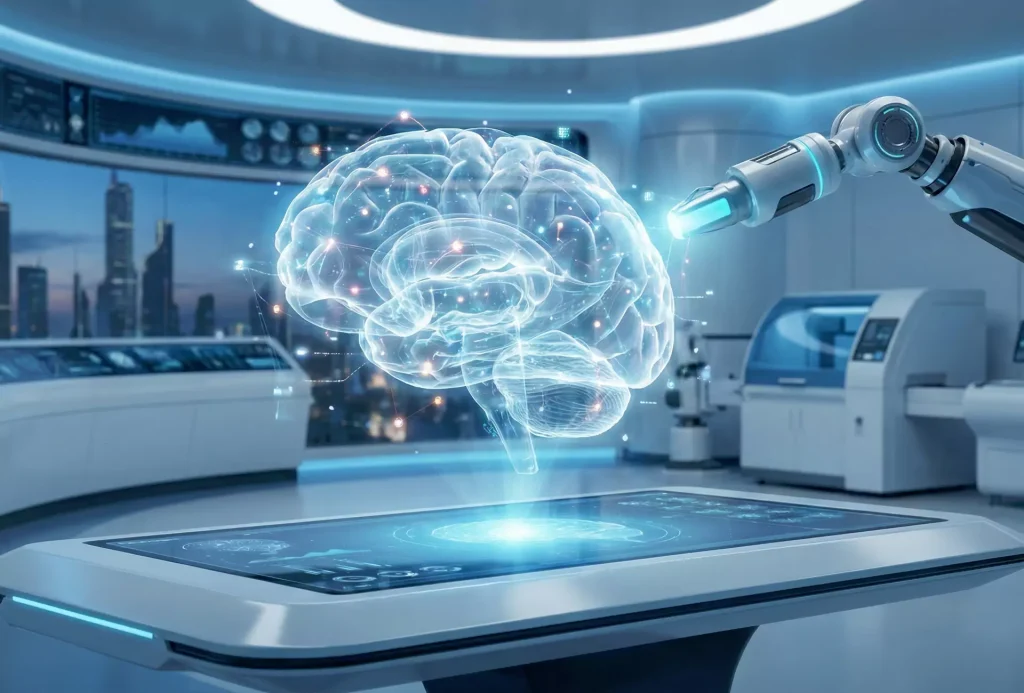
You’re sitting in an exam room, but your doctor isn’t looking at you; instead, they’re looking at a screen. Behind that screen, an algorithm is processing your entire medical history in milliseconds. It’s faster than any human, it’s incredibly precise, and it never gets tired. But as the machine analyzes your data, a haunting question remains: Can a line of code ever truly understand your pain?
As artificial intelligence moves from the research lab to the hospital bedside, the medical world is divided. Are we witnessing the slow end of the human physician, or the beginning of a powerful new partnership that will save millions of lives? To find the answer, we have to look past the hype and dive into the reality of how technology is reshaping the future of care.
What You’ll Learn (TL;DR)
- The Core Debate: Why experts are divided on whether machines can ever hold a stethoscope.
- AI’s Superpowers: How algorithms outperform humans in speed and data processing.
- The Human Edge: Why empathy, ethics, and “gut feeling” are impossible to code.
- The Hybrid Future: How the “Augmented Doctor” is becoming the new gold standard.
- Real-World Impact: How AI is already managing burnout and complex surgeries.
The Great Debate: Can AI Replace the Doctor?
Direct Answer: No, AI cannot fully replace a doctor, but it is fundamentally changing the role of medical professionals. While AI excels at analyzing data, spotting patterns in scans, and predicting risks, it lacks the emotional intelligence, ethical reasoning, and cultural nuance required to provide holistic patient care.
The debate isn’t just about technology; it is about the soul of medicine. For centuries, being a doctor meant using both science and “the human touch.” Today, we have machines that can “read” every medical textbook and research paper in existence in seconds. This creates a massive tension in the healthcare industry. Patients want the accuracy of a computer, but they still crave the reassurance of a human voice.
If we look at the numbers, AI is a clear winner in logic. However, healthcare isn’t always logical. It involves making tough choices when there is no “perfect” answer. A computer can tell you the probability of a treatment working, but it cannot help a family decide if that treatment aligns with their loved one’s final wishes. This is why the debate usually leads back to one conclusion: AI is a tool, not a replacement.
Why AI is Winning the Data War in Diagnosis
Infographic Suggestion (The Diagnosis Data War): A modern, minimal horizontal infographic with four distinct sections. Each section uses a thin-line vector icon and very limited text:
- Consistency: Icon of an eye overlapping a digital scan. Text: “24/7 Precision”.
- Speed: Icon of a stopwatch merging with a brain silhouette. Text: “Instant Triage”.
- Accuracy: Icon of a microscope focusing on a single glowing cell. Text: “Zero Fatigue”.
- Future Care: Icon of a DNA double helix made of binary code. Text: “Genomic Insights”. The color palette should be neutral (whites and grays) with a single accent color like electric blue.
AI dominates data-heavy medicine because it processes vast datasets with 100 percent consistency. It functions as a digital magnifying glass that finds early-stage diseases across thousands of medical images without the risk of human exhaustion.
Modern diagnosis often feels like finding a needle in a haystack. While the sheer volume of pixels and cells can overwhelm the human brain, AI thrives on this complexity. It maintains perfect precision from the first image of the day to the very last, eliminating the risk of cognitive fatigue.
To understand why AI is winning this “data war,” we can look at its impact across several critical areas:
- Unmatched Consistency in Radiology: A single radiologist might review 100 scans a day. By the afternoon, fatigue can cause the eyes to miss a tiny shadow. AI never blinks, never gets bored, and can process 1,000 scans with zero decline in accuracy.
- Rapid Diagnostic Speed (The Life-Saving Factor): In emergency cases like a stroke, every second counts because “time is brain.” AI can analyze a head CT scan in under two minutes to alert surgeons immediately. This replaces a human workflow that traditionally takes 30 to 60 minutes, turning a slow process into an instant revolution.
- Microscopic Precision in Pathology: Identifying cancer cells in tissue samples requires intense focus. AI software can scan these samples and highlight suspicious areas for the pathologist, ensuring that no malignant cell goes unnoticed.
- Genomic Pattern Recognition: AI can analyze a patient’s entire DNA sequence to predict their risk for future diseases. This allows for a level of personalized prevention that is impossible for a human doctor to calculate manually.
The “Human Element”: Why Empathy Cannot Be Coded
Empathy, shared decision-making, and bedside manner are aspects of care that AI cannot replicate. Healing involves more than just fixing a biological “glitch”; it requires understanding a patient’s fears, social context, and personal values, which are uniquely human traits.
Medical care is built on trust. When a patient is scared, they don’t want a printout of statistics; they want to look into someone’s eyes and feel that they are being heard. AI can simulate conversation using Large Language Models (LLMs), but it doesn’t actually “feel” anything. It is an imitation of empathy, not the real thing.
The Complexity of Human Intuition
There is also the factor of “clinical intuition.” Experienced doctors often talk about a “feeling” they get when a patient walks into the room. It’s a combination of subtle cues, such as the way a patient breathes, the color of their skin, or the tone of their voice. While we are trying to teach AI to recognize these patterns, a human’s ability to “read between the lines” remains far more sophisticated than any current algorithm.
| Feature | Artificial Intelligence (AI) | Human Physician |
| Information Processing | Processes billions of records in seconds | Limited to human memory and study |
| Decision Logic | Based on statistical probability | Based on ethics, logic, and intuition |
| Communication | Functional and data-driven | Empathetic and nuanced |
| Physical Task | High precision (Robotics) | High adaptability and touch |
AI in Surgery: The Rise of the Augmented Surgeon
In the operating room, AI is not replacing the surgeon but rather giving them “superhuman” capabilities. AI-assisted robotic systems filter out hand tremors, provide 3D magnified views, and use real-time data to guide the scalpel away from critical nerves and vessels.
Surgery is a game of millimeters. In the past, the success of an operation depended entirely on the steady hand of the surgeon. Today, “robotic surgery AI” acts as a digital co-pilot. If a surgeon’s hand has even a tiny, microscopic tremor, the robot’s software filters it out, making the actual cut perfectly smooth.
Precision Beyond the Human Hand
These robots allow for “minimally invasive” surgery. Instead of a large 10-inch incision, a robot can work through a hole the size of a dime. AI helps by mapping the patient’s internal anatomy in real-time, essentially giving the surgeon “X-ray vision.” The patient loses less blood, feels less pain, and goes home much sooner. This is the perfect example of AI working for the doctor, not instead of them.
Can AI Replace the Doctor in Remote Areas?
In underserved or remote regions, AI may temporarily act as a “surrogate doctor” by providing basic triage and diagnostic support where human specialists are unavailable. However, its role remains to bridge the gap until human care can be accessed.
In many parts of the world, there simply aren’t enough doctors. In some rural areas, a patient might have to travel for days to see a specialist. Here, AI is a literal lifesaver. A local nurse can use an AI app on a smartphone to scan a wound or listen to a heart rhythm, and the AI can provide an immediate risk assessment.
Telemedicine and Predictive Risk
This technology is bringing “Tier 1” medical knowledge to the most remote corners of the planet. While an app isn’t as good as a cardiologist, it is infinitely better than having no help at all. By triaging patients, AI ensures that the few doctors available spend their time on the most critical cases.
For more information about Telemedicine, you can read “What Is Telemedicine in Medical Tourism?”
The “Black Box” and the Ethics of Accountability
A major barrier to AI replacing doctors is the “Black Box” problem, which refers to the inability of some AI models to explain why they reached a specific conclusion. For AI to be integrated into care, it must be “Explainable AI” (XAI) so that doctors can verify and trust its logic.
Medicine is a field of accountability. If a doctor makes a mistake, there is a clear legal and ethical process. But if an AI makes a mistake, who is to blame? Is it the company that wrote the code? The hospital that bought the software? This lack of transparency is a major hurdle.
Bias in the Machine
Algorithms are only as fair as the data they are fed. If an AI is trained only on data from one demographic, it might fail when treating someone from a different background. Doctors must act as the ultimate “sanity check,” ensuring that the machine’s suggestions make sense for the unique human being standing in front of them.
Solving the Burnout Crisis: AI as the Administrative Hero
While the debate focuses on clinical replacement, AI’s most immediate success is replacing “paperwork,” specifically the tasks that doctors hate, allowing them to focus on the patients they love. By automating medical coding, clinical notes, and scheduling, AI serves as an essential administrative assistant.
The number one reason doctors leave the profession today isn’t that they are tired of healing; it’s because they are tired of typing. “Clinical documentation” has become a massive burden. AI “scribes” can now listen to a doctor-patient conversation and create a perfect medical note automatically. This returns the doctor’s attention to the patient, where it belongs.
Summary: The Future of Medicine is Collaborative
The debate of “Can AI replace the doctor?” usually ends in a draw. Machines are better at memory and speed; humans are better at heart and judgment. The future of healthcare is not a “man vs. machine” battle. It is a partnership where AI handles the data-heavy, repetitive tasks, freeing the doctor to be more human. Advanced AI-driven tools are simply new instruments in the doctor’s bag, much like the stethoscope was a century ago.
At Nova Voya, we leverage advanced AI to provide you with seamless access to top-tier clinics, hospitals, and medical professionals worldwide. Our advanced search engine helps you find the best healthcare providers tailored to your specific needs. To explore all providers and start your search, click the link below:
If you were in the hospital, would you feel more comfortable knowing a machine checked your scans twice, or do you find the idea of AI in your care scary? Share your thoughts in the comments below!
Frequently Asked Questions
Currently, no. AI does not have legal “personhood” and cannot be held liable. It serves as a Decision Support System (DSS) rather than an independent medical professional.
You should trust the combination. Research shows that “Doctor + AI” consistently outperforms “Doctor alone” or “AI alone.”
No. Many AI tools are cloud-based and can be accessed via a simple tablet or smartphone, making them available to small clinics and rural areas.
Many hospitals are now transparent about using AI for things like reading X-rays or checking for drug interactions. You can always ask your provider what tools they use to assist their diagnosis.