

Medical tourism is a booming industry, offering patients worldwide access to high-quality, often more affordable, healthcare. But for clinics, hospitals, and facilitators, attracting international patients is only half the battle. The real challenge, and the greatest opportunity, lies in medical tourism lead conversion and cultivating robust referral networks in healthcare.
This guide will walk you through actionable strategies, from optimizing your initial patient interactions to building long-lasting partnerships that drive sustainable growth. Get ready to transform your approach to international patient acquisition.
- Key Takeaways: What You'll Learn
- Understanding Lead Conversion in Medical Tourism
- Strategies to Convert Medical Tourism Leads
- 1. Implement Lead Qualification Systems
- 2. Use CRM tools to segment serious inquiries vs. casual prospects.
- 3. Score leads based on intent (budget, medical need, travel readiness)
- 4. Prioritize high-quality leads for faster conversion
- 5. Optimize Response Time & Communication
- 6. Respond to patient inquiries within 1-2 hours
- 7. Offer 24/7 multilingual support (live chat, WhatsApp, email)
- 8. Use automation for initial responses, but follow up with human interaction
- 9. Provide Transparent Pricing & Treatment Packages
- 10. Offer clear cost breakdowns (treatment, accommodation, travel)
- 11. Create downloadable “treatment + travel” bundles
- 12. Reduce friction by showing competitive but realistic pricing
- 13. Build Trust with Medical Credentials & Testimonials
- 14. Showcase surgeon/hospital accreditations and success rates.
- 15. Share verified patient testimonials and before/after case studies
- 16. Include video stories to build an emotional connection
- Claim Your Free Discovery Call Today
- 17. Use Personalized Nurturing Campaigns
- 18. Create email drip campaigns for patients still considering options
- 19. Share relevant content (procedure guides, recovery tips, cultural advice)
- 20. Offer a “personal patient coordinator” to guide them through the journey
- 21. Simplify the Patient Journey
- 22. Provide concierge services (visa support, airport pickup, hotel booking)
- 23. Offer digital pre-consultations with doctors
- 24. Create easy-to-follow step-by-step guides for international patients
- Ready to grow your healthcare facility and attract international patients?
- The Role of Referral Networks in Medical Tourism
- Why Referral Networks Drive Growth in Healthcare Travel
- 1. Identify and Onboard the Right Partners
- 2. Create Structured Incentive Programs for Referrals
- 3. Develop Patient Ambassador & Loyalty Programs
- 4. Track, Measure, and Reward Referrals with Technology
- 5. Address Legal and Ethical Considerations in Global Referrals
- Claim Your Free Discovery Call Today
- Integrating Lead Conversion and Referral Strategies
- Case Studies of Successful Medical Tourism Businesses
- Future Trends in Medical Tourism Marketing
- Conclusion
- Frequently Asked Questions
Key Takeaways: What You’ll Learn
- How to prioritize high-intent international patient leads using simple qualification scoring.
- The critical role of response time and multilingual support in the conversion process.
- Step-by-step guidance on building structured and ethical patient and partner referral networks in healthcare.
- Practical strategies to integrate lead nurturing and referral tracking using modern technology.
Claim Your Free Discovery Call Today
Let’s discuss your goals, assess your current marketing challenges, and identify powerful opportunities for growth.
Book a Free Discovery CallA private, no-obligation strategy session for ambitious healthcare leaders.
Understanding Lead Conversion in Medical Tourism
Lead conversion in medical tourism is the process of turning an initial international patient inquiry (a prospect or lead) into a booked, paying patient who travels for treatment. This process is complex, high-stakes, and requires far more trust and personalized interaction than standard domestic healthcare.
For medical tourism facilitators, hospitals, and clinics, success isn’t just about attracting clicks; it’s about mastering the delicate transition from interest to commitment. Because these patients are committing to travel across borders for a medical procedure, the stakes (emotional, financial, and physical) are significantly higher, which makes conversion slower and more dependent on trust.
What makes medical tourism leads unique?
Medical tourism leads are unique because they are navigating two major decisions simultaneously: selecting a medical provider and choosing an international travel destination.
Unlike local leads, international prospects are typically in the deep research phase. They have specific, often urgent, medical needs and are comparing costs, quality, and logistics across multiple providers globally. Their inquiries are not casual; they are highly motivated, but also highly cautious. Their conversion hinges on how effectively a provider can bridge the geographic and trust gap.
Key challenges in converting international patients
The conversion process is riddled with unique friction points that can derail a potential patient. The primary challenges involve overcoming distance, skepticism, and regulatory differences. To successfully convert these leads, you must directly address these hurdles:
- Lack of Trust and Transparency: Patients are often hesitant to commit to a procedure thousands of miles away without personal reassurance. They need proof of quality.
- Logistical Complexity: Dealing with visas, flight booking, accommodation, and post-procedure recovery logistics can overwhelm a lead and cause them to abandon the process.
- Communication Gaps: Language barriers, time zone differences, and lack of 24/7 access to information are major obstacles.
- The Cost Factor: While seeking savings, patients often fear hidden costs or subpar care associated with lower prices, making clear, transparent pricing essential.
Critical touchpoints in the global patient journey
The journey of an international patient is long and involves several critical stages, each representing a crucial conversion opportunity. Mapping these touchpoints allows for targeted communication. Here are the critical steps in the patient journey where conversion strategies must be applied:
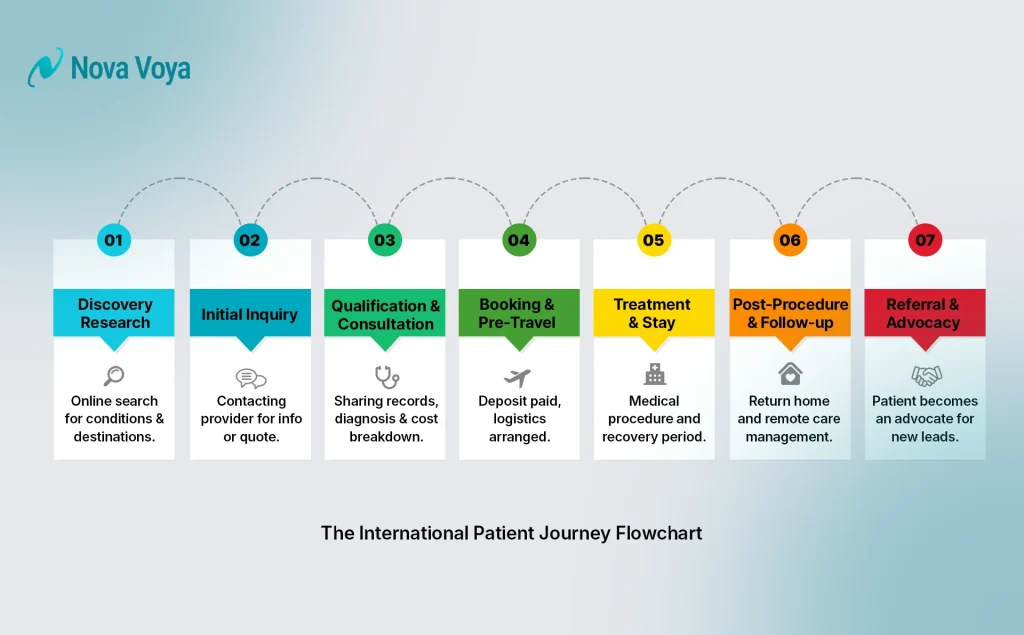
- Discovery/Research: The patient searches online for conditions, treatments, and destinations (Top of Funnel).
- Initial Inquiry: The lead contacts the provider (email, form, chat) seeking information or a quote (Middle of Funnel).
- Qualification & Consultation: The lead shares medical records; the provider offers a diagnosis/plan and cost breakdown. This is a primary conversion hurdle.
- Booking & Pre-Travel: The patient accepts the quote and pays a deposit. Logistics (flights, accommodation) are arranged.
- Treatment & Stay: The actual medical procedure and recovery period occur.
- Post-Procedure & Follow-up: The patient returns home, and remote care and follow-up are managed.
- Referral & Advocacy: The patient becomes an advocate and refers new leads.
For further information, you can read “The Online Patient Journey: Researching and Choosing Providers”.
Strategies to Convert Medical Tourism Leads
To succeed at converting leads in medical travel, you must execute strategies that are fast, personalized, and hyper-focused on eliminating friction and building deep trust.
1. Implement Lead Qualification Systems
Lead qualification is the practice of identifying which inquiries are most likely to convert, allowing your team to focus time and resources effectively. A casual prospect asking a general question should not receive the same immediate high-touch effort as someone who has already submitted their medical records and is asking for specific surgery dates.
2. Use CRM tools to segment serious inquiries vs. casual prospects.
A Customer Relationship Management (CRM) system is non-negotiable for patient lead generation in medical tourism. Use your CRM to categorize leads immediately:
- MQL (Marketing Qualified Lead): Downloads a brochure, reads 5+ pages, or signs up for a newsletter.
- SQL (Sales Qualified Lead): Submits a detailed inquiry form, asks for a price quote, or requests a virtual consultation.
3. Score leads based on intent (budget, medical need, travel readiness)
Implement a simple lead scoring system. Assign points based on specific actions and data points gathered during the initial inquiry:
| Action / Data Point | Score (Points) | Intent Level |
| Submitted medical records | +25 | High |
| Asked for specific dates | +20 | High |
| Inquiry via WhatsApp/Phone | +15 | Medium |
| Mentioned a specific budget | +10 | Medium |
| General inquiry via web form | +5 | Low |
A score above 50, for example, signals a high-quality lead that needs immediate follow-up by a dedicated patient coordinator.
4. Prioritize high-quality leads for faster conversion
Always prioritize high-score leads. They are closest to the point of decision. Your best coordinators should be assigned to these leads to maximize the chance of conversion. This is the essence of effective medical tourism lead conversion.
5. Optimize Response Time & Communication
The single most critical factor in converting an international lead is speed. A lead is likely contacting 3-5 competitors at the same time. The first one to provide a comprehensive, human response often wins the patient.
6. Respond to patient inquiries within 1-2 hours
Aim for a response within one hour, even if the initial reply is just to acknowledge receipt and confirm when a medical professional will review their case. The goal is to set clear expectations and prevent the patient from moving to the next provider on their list.
7. Offer 24/7 multilingual support (live chat, WhatsApp, email)
Because of time zone differences, support must be available 24/7. WhatsApp is often the communication channel of choice for international patients due to its reliability and low cost. Ensure you have native or highly proficient language speakers covering your primary target markets.
8. Use automation for initial responses, but follow up with human interaction
Use chatbots or auto-responders for instant acknowledgment. Crucially, the automation should quickly transition the patient to a live human (the patient coordinator) for the personalized attention necessary to close the deal.
9. Provide Transparent Pricing & Treatment Packages
Financial transparency builds immediate trust and is often the final piece of the puzzle for a prospective patient. International patients want cost savings, but they demand certainty.
10. Offer clear cost breakdowns (treatment, accommodation, travel)
Break down the total cost into clear, itemized components. This should include:
- Surgeon fees and hospital costs
- Pre-op and post-op testing
- Accommodation and meals
- Concierge services (airport pickup, translation)
- Estimated duration of stay
11. Create downloadable “treatment + travel” bundles
Package the entire experience. Instead of just a medical quote, offer a “Recovery Retreat” or “Wellness Package” that includes treatment, a recovery hotel stay, and transportation. This simplifies decision-making.
12. Reduce friction by showing competitive but realistic pricing
Do not try to be the absolute cheapest, as this raises red flags about quality. Instead, focus on showing the value comparison; i.e., this procedure costs $X in the U.S. or U.K., but $Y (including flights/accommodation) with us, for the same accredited quality.
13. Build Trust with Medical Credentials & Testimonials
Trust is the currency of medical tourism. Since a patient cannot easily visit your facility before treatment, you must bring the proof of quality to them digitally.
14. Showcase surgeon/hospital accreditations and success rates.
Feature your international accreditations (JCI, TEMOS, ISQua) prominently. Include surgeon biographies with education, fellowships, and verifiable experience. Quantify success rates or complication rates where ethically appropriate.
15. Share verified patient testimonials and before/after case studies
Patient stories are your most powerful tool for medical tourism marketing strategies. Ensure testimonials are authentic and verifiable. Use case studies that clearly outline the patient’s condition, the treatment received, and the positive outcome.
16. Include video stories to build an emotional connection
Video content is essential for building emotional trust. A short, high-quality video of a satisfied international patient describing their experience is far more impactful than text alone.
Claim Your Free Discovery Call Today
Let’s discuss your goals, assess your current marketing challenges, and identify powerful opportunities for growth.
Book a Free Discovery CallA private, no-obligation strategy session for ambitious healthcare leaders.
17. Use Personalized Nurturing Campaigns
Personalized nurturing ensures that leads who aren’t ready to book today don’t forget you tomorrow. This is crucial for leads in the comparison phase.
18. Create email drip campaigns for patients still considering options
Segment your “Considering” leads and enroll them in a drip campaign that sends valuable, non-sales content over several weeks.
- Week 1: Introduction to the facility, highlighting accreditations.
- Week 2: A procedure guide related to their specific medical inquiry.
- Week 3: Testimonials or a success story video.
- Week 4: An invitation to a free, no-obligation video consultation.
19. Share relevant content (procedure guides, recovery tips, cultural advice)
Establish your clinic as an authority by providing educational content. If a lead is interested in hip replacement, send them information on recovery exercises, local accommodation suitable for mobility, and cultural tips for their travel.
20. Offer a “personal patient coordinator” to guide them through the journey
Assigning a dedicated coordinator immediately personalizes the experience. This person acts as the single point of contact, reducing patient stress and confusion.
21. Simplify the Patient Journey
Friction is the silent killer of conversion. The more steps required of the patient, the higher the chance of dropout.
22. Provide concierge services (visa support, airport pickup, hotel booking)
Offer a suite of services that goes beyond the medical procedure. Many facilitators and hospitals successfully convert leads by providing end-to-end logistics support. This simplifies the travel component and adds immediate value.
23. Offer digital pre-consultations with doctors
A video consultation with the surgeon before travel is a powerful trust-builder and helps with the final conversion decision. It allows the patient to ask detailed medical questions and meet the team virtually.
24. Create easy-to-follow step-by-step guides for international patients
Provide clear, visual checklists for everything: “Your Pre-Travel Checklist,” “What to Pack,” “Arrival Day Itinerary.” This reduces anxiety and demonstrates professionalism.
Ready to grow your healthcare facility and attract international patients?
Nova Voya helps clinical brands stand out, build industry authority, and convert patient inquiries efficiently with fully compliant, data-driven marketing frameworks.
Explore Healthcare MarketingThe Role of Referral Networks in Medical Tourism
While effective lead conversion focuses on the individual patient journey, building robust referral networks in healthcare focuses on creating sustainable, predictable patient flow over time. These networks transform one-time patients into continuous business generators.
Why Referral Networks Drive Growth in Healthcare Travel
Referrals are highly trusted, carry inherent social proof, and significantly reduce the cost of acquisition (CAC). When a patient or partner refers someone, they are essentially endorsing your quality, which immediately overcomes the initial trust barrier that typically slows down medical tourism lead conversion. Referred leads often convert faster and spend more. To capitalize on these significant advantages, the next step is establishing the right foundation by strategically identifying and onboarding reliable partners.
1. Identify and Onboard the Right Partners
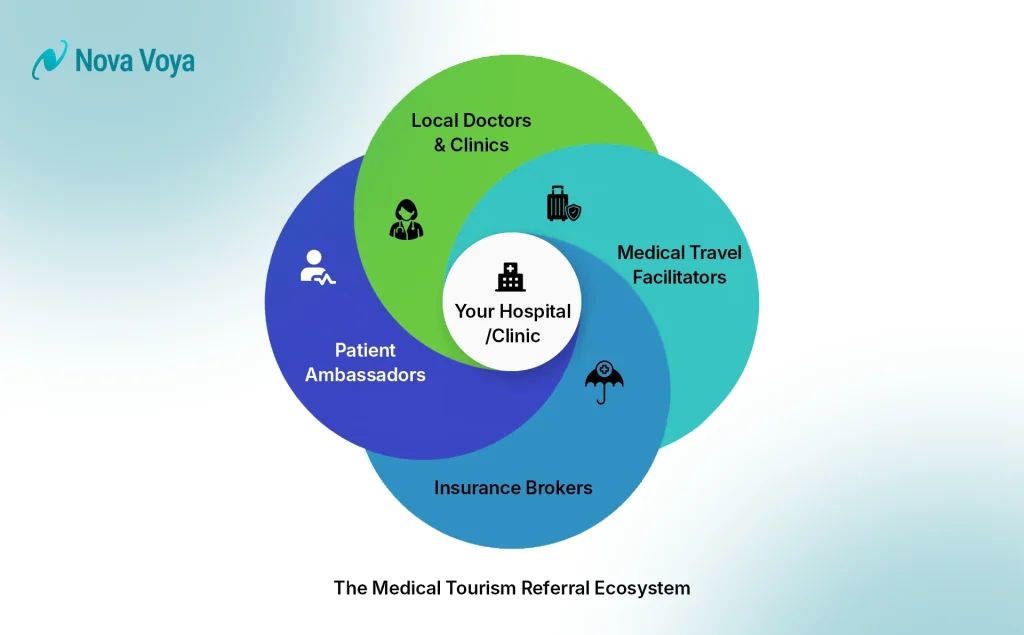
Strategic partnerships are the backbone of a high-performing medical tourism business. You need to identify who holds the trust of your potential patients. To build a reliable, high-volume network, focus on recruiting partners that align with specific needs in the patient’s home country or destination:
Ideal Referral Partners are:
- Small, Local Clinics/Doctors (Sending): General practitioners who cannot offer specialized care but have patient trust.
- Health Insurance Brokers/Third-Party Payers: Entities looking for cost-effective, high-quality treatment options for their clients.
- Travel Agencies/Facilitators (Receiving): Local entities at the patient’s destination who can provide post-treatment support.
- Patient Advocacy Groups/Expat Communities: Non-profit or social groups looking to share information with their members.
2. Create Structured Incentive Programs for Referrals
For a referral program to be sustainable, it must be structured, transparent, and mutually beneficial. Casual “thank yous” don’t build a network; clear compensation and rewards do.
For professional partners (doctors, facilitators), setting up clear tiers based on performance is essential. A structured example looks like this:
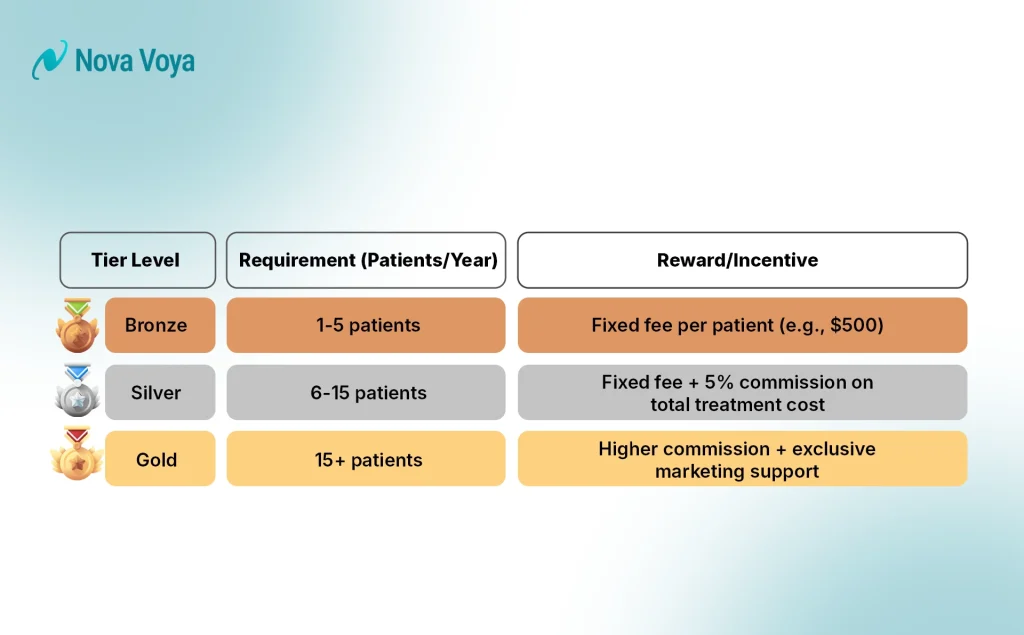
3. Develop Patient Ambassador & Loyalty Programs
The most effective and ethical referrals often come from satisfied former patients. To convert this organic goodwill into a structured growth channel, you can develop two primary types of patient-centric programs:
- Ambassador Program: Invite delighted patients to share their story (video, blog post) in exchange for a small financial gift, travel voucher, or discount on future services. Crucially, ensure this reward is not directly tied to the outcome of a referral to maintain ethical standards.
- Loyalty Program: For procedures requiring follow-up (e.g., dental or cosmetic), offer loyalty discounts on maintenance visits or subsequent treatments.
4. Track, Measure, and Reward Referrals with Technology
You cannot manage what you do not measure. A critical component of successful patient referral programs in medical tourism is a tracking system.
- Unique ID/Code: Provide each partner or patient ambassador with a unique tracking code or URL.
- CRM Integration: The CRM must be able to flag incoming leads based on this code and attribute the final conversion to the correct source.
- Automated Payouts: Use technology to automatically calculate referral commissions quarterly or semi-annually, ensuring rewards are delivered promptly to maintain partner motivation.
5. Address Legal and Ethical Considerations in Global Referrals
The biggest question is: Are referral programs in medical tourism legal and ethical?
Yes, they are, but they must be carefully managed. Ethical pitfalls arise when incentives become excessive or when they compromise patient autonomy.
- Transparency: All incentives must be clearly disclosed to the patient.
- Compliance: Be aware of local anti-kickback laws (like the U.S. Anti-Kickback Statute) and global regulatory bodies. Consult a legal expert specializing in global healthcare referrals.
- Patient Autonomy: The decision for treatment must always rest with the patient, uninfluenced by the referrer’s financial gain. Focus on rewarding the act of introduction, not the medical outcome.
Claim Your Free Discovery Call Today
Let’s discuss your goals, assess your current marketing challenges, and identify powerful opportunities for growth.
Book a Free Discovery CallA private, no-obligation strategy session for ambitious healthcare leaders.
Integrating Lead Conversion and Referral Strategies
The most successful medical tourism businesses don’t treat lead conversion and referrals as separate functions; they integrate them into a seamless growth loop. To achieve this overlap and create a strong growth loop between converting leads and building referral networks in medical tourism, you must integrate the following three key strategies into your marketing structure:
1. Align CRM and Referral Tracking Systems
Your CRM is the central nervous system for both strategies. Ensure that when a new referral partner is onboarded, they are immediately added to the CRM and assigned a unique tracking ID. This ID should populate automatically in the lead’s profile, connecting the lead generation source (referral) directly to the conversion process (follow-up).
2. Use Data Analytics to Optimize Conversions & Referrals
Data is the fuel for sustainable growth. By analyzing your entire patient flow, you can identify where to invest resources.
- Conversion Rate by Source: Track which referral partners or marketing channels yield the highest conversion rates. Invest more in the highest performers.
- Time-to-Conversion: Compare the time it takes for a referral lead to book versus a cold lead. This proves the value of the referral network.
- LTV (Lifetime Value) by Source: Analyze the revenue generated by referred patients versus non-referred patients.
Case Studies of Successful Medical Tourism Businesses
Consider this success scenario:
- A cosmetic surgery clinic partners with 10 high-end destination travel agencies.
- They use a CRM to track a unique partner code (TA-101, TA-102, etc.) on all incoming inquiries.
- They find that leads from TA-101 convert at 25% (vs. 10% for cold leads), and the average ticket size is 30% higher.
- Action: The clinic increases the incentive for TA-101 and re-invests 50% of the savings from reduced marketing spend into recruiting more partners like TA-101.
Future Trends in Medical Tourism Marketing
Staying ahead means understanding how technology will continue to shape medical tourism lead conversion and referrals.
AI and Automation in Lead Management
Artificial Intelligence is rapidly evolving from simple chatbots to sophisticated lead management tools.
- Predictive Lead Scoring: AI will analyze past patient data (demographics, inquiry language, web behavior) to predict the likelihood of conversion more accurately than manual scoring systems.
- Personalized Routing: Leads will be automatically routed to the best-suited patient coordinator based on language, time zone, and medical specialty.
The Rise of Patient Influencers and Digital Communities
While traditional referrals are professional, social referrals are becoming crucial. Patients increasingly rely on digital communities and social media influencers (people who have undergone the treatment) for authentic, unbiased advice.
- Strategy: Build formal relationships with highly-vetted “patient influencers” and provide them with educational content and resources, allowing them to ethically share their positive experiences.
Telemedicine as a Gateway for Lead Conversion
Telemedicine is shifting from just being a follow-up tool to a powerful lead generation strategy. This shift involves two primary, low-friction methods for engaging potential patients and drawing them into the conversion funnel:
- Free Virtual Screening: Offering a free, short telemedicine screening with a non-surgeon specialist act as a low-friction entry point for a lead to move from inquiry to pre-qualification.
- Second Opinions: Use telemedicine to provide quick second opinions, capturing leads who are already far along in their research process with another provider.
For more information, please refer to “Telemedicine for Pre-Consultation and Post-Treatment Follow-Up”
Conclusion
Mastering medical tourism lead conversion and fostering patient referral programs medical tourism are the two pillars of sustainable international patient acquisition. Conversion demands speed, transparency, and high-touch personalization, particularly through dedicated patient coordinators and ethical pricing. Referral growth requires structured, mutually beneficial partnerships, underpinned by rigorous tracking and compliance. By integrating these strategies and leveraging data and emerging trends like AI and telemedicine, your organization can move beyond relying on costly ad campaigns to build a powerful, self-sustaining growth engine.
Healthcare Marketing Services
Data-driven marketing solutions tailored for medical growth
- ✔️ Strategic patient acquisition and high-converting performance marketing
- ✔️ Authority brand strategy with advanced SEO and Answer Engine Optimization (AEO)
- ✔️ Patient-centric web design, CRM automation, and compliant reputation management
Elevate your
Healthcare Brand
Book a Discovery CallTurn your unique medical story into measurable global results.
What is the single biggest challenge you currently face in converting leads who come from different time zones? Let us know in the comments!
Frequently Asked Questions
The best strategies focus on rapid, personalized, and transparent communication. Key steps include lead scoring (to prioritize high-intent inquiries), a sub-2-hour response time, transparent all-inclusive pricing, and a dedicated, multilingual patient coordinator.
Referral networks in healthcare drive growth by reducing acquisition cost and shortening conversion time. They provide a predictable, scalable stream of high-quality patients because referred leads inherently come with pre-built trust.
The most effective tools are robust CRM systems. They must assign unique tracking codes to partners to automatically attribute conversions and calculate commissions.
Yes, they are legal and ethical when based on transparency and patient autonomy. Incentives must be disclosed, tied only to the act of introduction, and the program must comply with all relevant anti-kickback and data privacy laws.
Clinics improve trust by showcasing verifiable quality through international accreditations (JCI) and transparent success rates. Key strategies include sharing video testimonials and offering free, secure virtual consultations with the physician.