
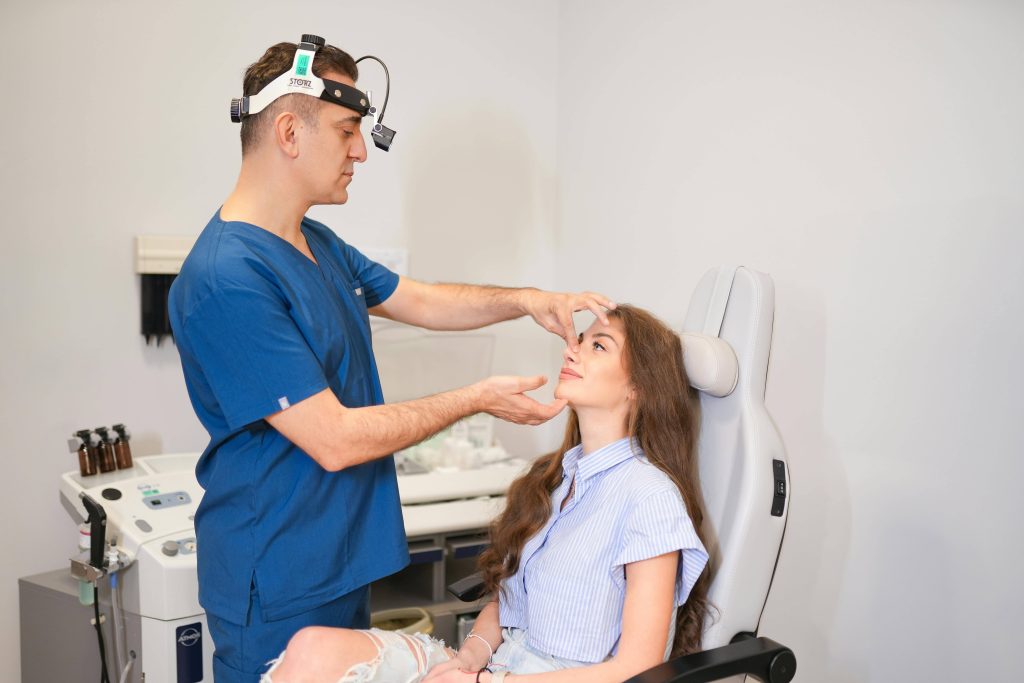
If you’ve been researching rhinoplasty, you’ve probably come across two very different paths: the classic surgical route that reshapes your nose permanently, and the newer non-surgical option that uses fillers to tweak your nose in under an hour.
Both can transform the way your nose looks. But they work in completely different ways, suit different situations, and come with their own sets of risks and benefits.
This guide cuts through the confusion. We’re using the findings from a 2025 peer-reviewed systematic review of 2,048 patients to give you accurate, evidence-based answers; not opinions.
- Key Takeaways: (TL;DR)
- What Is Surgical Rhinoplasty And Who Is It For?
- What Is Non-Surgical Rhinoplasty And How Does It Work?
- Surgical vs. Non-Surgical Rhinoplasty: The Side-by-Side Breakdown
- What Can Non-Surgical Rhinoplasty Fix After Surgery?
- Satisfaction Rates: What the Research Says
- Complication Rates: What's the Real Risk?
- Where to Get a Surgical vs Non-Surgical Rhinoplasty in Dubai
- Myth vs. Reality: Surgical Rhinoplasty vs Non-Surgical Rhinoplasty
- Summary
- FAQs
Key Takeaways: (TL;DR)
- Surgical rhinoplasty reshapes the nose permanently but carries a revision rate of 5–20%, making it one of the most technically complex cosmetic procedures.
- Non-surgical rhinoplasty (NSR) uses injectable fillers to correct nose shape without going under the knife; faster, cheaper, and less risky.
- Hyaluronic acid is the most popular filler, used in 67% of non-surgical rhinoplasty cases reviewed in recent research.
- Patient satisfaction for non-surgical rhinoplasty stands at over 85%, with some long-term studies hitting 97–100%.
- Major complications from NSR are rare, under 1% of cases, though skin necrosis is the most serious risk to watch for.
- If you’ve already had a surgical rhinoplasty and aren’t happy with the results, NSR can help fix post-op defects without going back to the operating room.
- Valiant Clinic Dubai stands out for surgical rhinoplasty with dedicated rhinoplasty surgeons on staff.
Dr. Alireza Mohebbi
ENT Specialist & Board-Certified Facial Plastic Surgeon · 23 Years Experience
What Is Surgical Rhinoplasty And Who Is It For?
Surgical rhinoplasty is a procedure where a surgeon physically alters the bone and cartilage structure of your nose. It can reduce a hump, narrow the width, lift the tip, correct breathing problems, or change the overall shape of your nose. The changes are permanent.
How It’s Done
Surgeons make incisions either inside the nostrils (closed rhinoplasty) or across the strip of skin between the nostrils (open rhinoplasty). They then reshape cartilage, remove or add tissue, and reposition the nasal structure to achieve the desired result.
The Good News
- Permanent results, one procedure can solve your concern long-term
- Can address both aesthetic and functional issues (like a deviated septum)
- A wide range of corrections is possible, from subtle to dramatic
The Hard Truth
The research is clear: rhinoplasty has one of the highest revision rates in cosmetic surgery, between 5% and 20%. Because differences in skin thickness, cartilage quality, and how your body heals after surgery make the final result genuinely unpredictable.
Revision rhinoplasty is more complex and riskier than the original procedure, often requiring cartilage from elsewhere in your body or from a donor.
The nose’s position at the center of the face means even minor imperfections are visible; saddle nose (A depression in the nasal bridge, often seen after trauma or failed surgery), inverted V deformity (A post-surgical defect where the nose looks pinched at the cartilage-bone junction), alar retraction, tip irregularities. These are common post-surgical sequelae that surgeons and patients alike struggle to predict.
What Is Non-Surgical Rhinoplasty And How Does It Work?
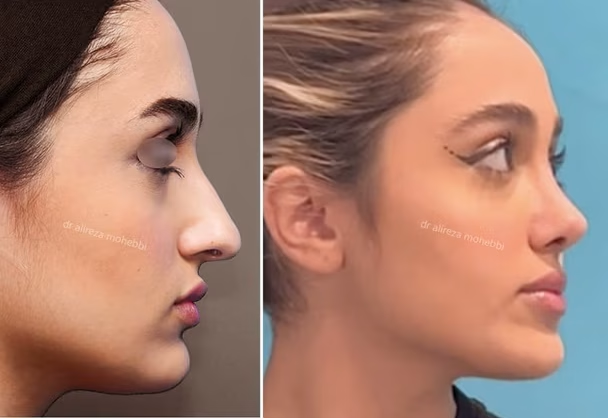
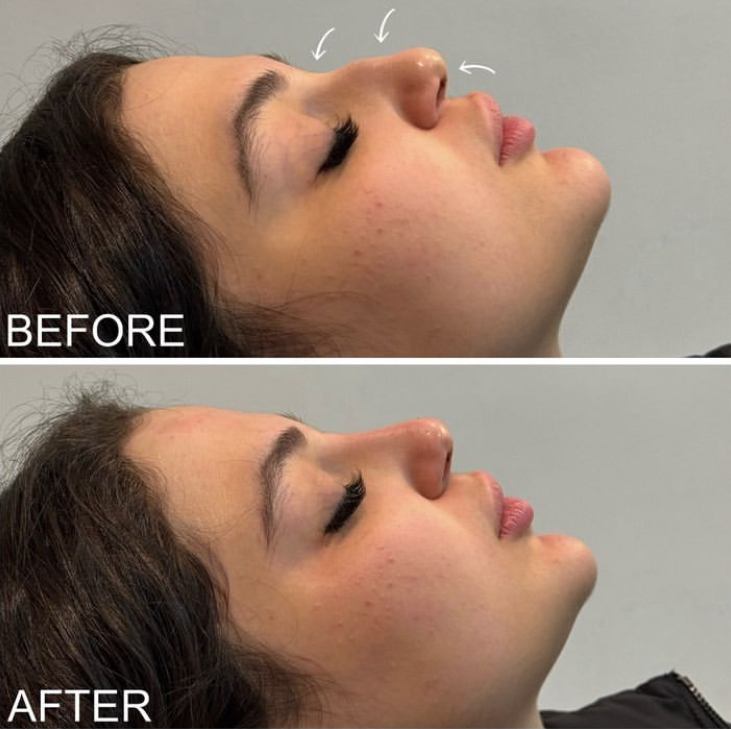
Non-surgical rhinoplasty (NSR), also called liquid rhinoplasty, uses injectable fillers to reshape, smooth, or correct the appearance of the nose; without cutting, anesthesia, or downtime.
It’s most effective for adding volume, correcting asymmetries, smoothing bumps, and fixing irregularities after a previous rhinoplasty; not for reducing the overall size of the nose (remember, fillers add volume, they can’t remove it).
How It’s Done
A trained clinician injects filler material into specific areas of the nose using a fine needle or cannula. The most common filler used is hyaluronic acid (The most common filler used; naturally occurring in the body, reversible), which is reversible, meaning it can be dissolved if you don’t like the result.
The whole procedure typically takes under an hour, with minimal recovery time.
Filler Types at a Glance
| Filler Type | Key Feature |
| Hyaluronic Acid (HA) | Reversible, most studied |
| Calcium Hydroxyapatite | Longer-lasting results |
| Injectable Silicone | Permanent, significant risk warnings |
| Polymethylmethacrylate (PMMA) | Permanent, less common |
| Autologous Fat | Natural material from patient’s own body |
| Collagen Matrix | Very rare use |
Note: Injectable silicone has faced significant regulatory warnings since the 1990s. Hyaluronic acid and calcium hydroxyapatite together account for 78% of cases and are considered the two standard options in modern practice.
The Good News
- No surgery, no general anesthesia, no hospital stay
- Results are visible immediately
- Recovery is minimal, most people return to normal activities the same day
- Hyaluronic acid results are reversible if you change your mind
- Can fix post-rhinoplasty defects without another surgery
- Lower cost compared to surgical rhinoplasty
The Hard Truth
Non-surgical rhinoplasty has real limitations. Because it only adds volume, it can’t reduce nose size or fundamentally change your nasal architecture. It also requires maintenance; fillers are temporary and results fade over time.
More importantly, it’s not risk-free. Skin necrosis (tissue death) is the most serious complication, occurring in a small but meaningful number of cases. And critically: patients who have already had surgical rhinoplasty face a higher risk of this complication, because previous surgery can disrupt blood flow in the nose.
The research recommends waiting at least 12 months after a surgical rhinoplasty before getting any filler injections in the same area.
Surgical vs. Non-Surgical Rhinoplasty: The Side-by-Side Breakdown
| Factor | Surgical Rhinoplasty | Non-Surgical Rhinoplasty |
| Permanence | Permanent | Temporary (months to 1–2 years) |
| Downtime | Weeks | Minimal to none |
| Anesthesia | General or local + sedation | Topical only |
| Can reduce nose size | Yes | No |
| Reversible | No | Yes (with HA fillers) |
| Revision rate | 5–20% | N/A (adjustable) |
| Suitable after prior rhinoplasty | Complex, higher risk | Yes, but with increased complication risk |
| Major complication rate | Varies by procedure | Under 1% |
| Patient satisfaction | Varies widely | Over 85% overall |
| Recommended wait after rhinoplasty | N/A | At least 12 months |
Dr. Alireza Mohebbi
ENT Specialist & Board-Certified Facial Plastic Surgeon · 23 Years Experience
What Can Non-Surgical Rhinoplasty Fix After Surgery?
One of the most important and underused, applications of NSR is correcting what surgical rhinoplasty leaves behind.
The 2025 systematic review analyzed 2,048 patients who had non-surgical rhinoplasty specifically after a prior surgical rhinoplasty. The most common areas treated included:
The Middle Third of the Nose (Keystone Area)
This is the junction between the bone and the cartilage in your nose. It’s one of the most technically difficult areas in surgery, and it’s also where post-surgical defects are most common. Common issues corrected here include:
- Saddle nose deformity, a depression in the nasal bridge
- Inverted V deformity, a visible V-shaped gap where the cartilage separates from the bone after surgery
- Small asymmetries or irregularities after osteotomies (bone reshaping)
The Upper Third
- Camouflaging bumps, irregularities, or visible bone after rhinoplasty
The Lower Third (Nasal Tip)
- Correcting tip rotation and projection problems
- Columellar retractions (where the strip between the nostrils looks pulled back)
Satisfaction Rates: What the Research Says
This is where the data gets reassuring, if you’re considering non-surgical rhinoplasty.
Across the 11 studies in the 2025 systematic review that reported patient satisfaction (covering 232 patients), the overall satisfaction rate exceeded 85%. The three studies with the longest follow-up periods showed satisfaction rates of 100%, 97%, and 87% respectively.
That said, there are honest caveats the researchers flag:
- Follow-up periods varied widely, from 1 month to 16 months
- Because fillers are temporary, satisfaction may change as results fade
- There’s no standardized way to measure satisfaction across studies, so comparisons between studies have limits
For surgical rhinoplasty, satisfaction data is more complex and context-dependent, with revision rates of 5–20% suggesting that a meaningful proportion of patients seek additional correction.
Complication Rates: What’s the Real Risk?
Non-Surgical Rhinoplasty Risks
Out of 2,048 patients reviewed in the 2025 study:
- 17 patients (0.83%) experienced a serious complication
- The most common serious complication was skin necrosis (tissue death), affecting 14 patients
- 2 patients experienced foreign body granuloma reactions
- 1 patient developed a skin abscess
Minor, temporary complications (like redness, swelling, and mild discomfort) were more common but resolved on their own.
Key finding from the research: Patients who had non-surgical rhinoplasty after a prior surgical rhinoplasty had a significantly higher risk of vascular complications than first-time non-surgical rhinoplasty patients. Previous surgery changes the blood vessel layout in the nose, reducing blood flow to the skin and increasing the chance of necrosis.
Where to Get a Surgical vs Non-Surgical Rhinoplasty in Dubai
Picking the right clinic for a rhinoplasty, surgical or not, matters just as much as understanding the procedure itself. Based on our clinical review of the 2025 research, expertise in nasal anatomy is non-negotiable. We looked at top-tier providers across Dubai so you can match your specific profile goals with the right specialist.
For Surgical & Reconstructive Precision: Prof. Roberto Puxeddu
If your goals require structural, permanent changes or if you are dealing with complex internal breathing issues, Prof. Roberto Puxeddu is a standout choice.
- Why He Is Recommended: Prof. Puxeddu is a highly decorated, UK and Italian board-certified Consultant Otorhinolaryngologist (ENT) and Head and Neck Surgeon. With deep expertise in functional endoscopic sinus surgery (FESS), septoplasty, and treating severe nasal obstructions, he approaches the nose from a perspective of absolute anatomical control.
- The Surgical Edge: Because the 2025 study highlights that post-operative defects (like saddle nose or inverted V deformities) often stem from unpredictable healing of the cartilage-bone junction, having a master of ENT anatomy minimizes structural risks. He is ideal for patients who need combined functional (breathing) and aesthetic nasal alterations.+1
- Languages: English and Italian.

Prof. Roberto Puxeddu
Consultant Otorhinolaryngologist (ENT) & Head and Neck Surgeon
UK & Italian Board Certified
For Dual-Approach Expertise (Surgical & Fillers): Dr. Dragana Spica
For patients who are on the fence between a permanent surgical alteration and a temporary liquid nose job, Dr. Dragana Spica offers a rare, balanced perspective.
- Why She Is Recommended: As a Specialist Plastic and Reconstructive Surgeon with 19 years of experience, Dr. Spica is the Lead of Aesthetic Clinics. She holds a Master’s degree in Surgical Anatomy, meaning she possesses the meticulous knowledge of facial blood vessels required to perform nasal procedures safely.
- The Non-Surgical and Surgical Edge: Dr. Spica is uniquely qualified for both paths. If you need permanent surgical reshaping (such as face/neck harmony or complex facial aesthetics), she has the board certifications to deliver. Crucially, if you opt for Non-Surgical Rhinoplasty, her deep training in surgical anatomy allows her to perform hyaluronic acid filler injections with the highest level of safety, drastically reducing the risk of vascular compromise or skin necrosis highlighted in recent research.
- Languages: English.

Dr. Dragana Spica
Lead of Aesthetic Clinics · Specialist Plastic & Reconstructive Surgeon
19+ Years Experience · MSc in Surgical Anatomy
For Comprehensive ENT Diagnostics & Pre-Op Care: Dr. Haitham Morsi
Rhinoplasty is never purely cosmetic; how your nose functions on the inside dictates how well it can be reshaped on the outside. This is where Dr. Haitham Morsi’s specialized care becomes invaluable.
- Why He Is Recommended: Dr. Morsi is an accomplished ENT specialist with over 15 years of experience in advanced rhinology, endoscopic septoplasty, and turbinoplasty.
- The Collaborative Edge: While Dr. Morsi focuses heavily on advanced rhinology and sinus surgeries, he acts as a crucial gatekeeper for rhinoplasty candidates. He regularly collaborates with top surgical teams in Dubai to provide comprehensive pre-operative ENT assessments and post-operative care coordination. If your rhinoplasty requires treating chronic sinusitis, structural septal issues, or internal valve collapses beforehand, Dr. Morsi ensures your nasal foundation is medically sound before any cosmetic changes are made.

Dr. Haitham Morsi
Leading Specialist Otolaryngologist (ENT)
15+ Years Experience · Graduate of Alexandria School of Medicine
Myth vs. Reality: Surgical Rhinoplasty vs Non-Surgical Rhinoplasty
| What People Assume | What the Research Shows |
| “Non-surgical rhinoplasty is completely safe” | It’s safer than surgery, but skin necrosis is a real risk, especially after prior surgery |
| “If I’ve already had a nose job, fillers are the safe fix” | Existing surgery increases complication risk, timing and technique matter even more |
| “Filler results last forever” | Most fillers are temporary; results change over time and require maintenance |
| “Only surgeons should do non-surgical rhinoplasty” | Any qualified and experienced filler practitioner can perform it, but expertise in nasal anatomy is essential |
Summary
There’s no one-size-fits-all answer when it comes to rhinoplasty. Both surgical and non-surgical approaches have a real and well-documented place in modern nose reshaping, the right choice comes down to your goals, your anatomy, your history, and your tolerance for risk and downtime.
What the research makes clear is this: non-surgical rhinoplasty, done correctly, delivers high satisfaction with a very low complication rate. And for people who’ve already had rhinoplasty and aren’t fully happy with their results, it can offer a meaningful, minimally invasive correction, without the complexity and risk of going back to the operating table.
The key word is “correctly.” Whoever performs your procedure (surgical or non-surgical) needs real expertise in nasal anatomy, genuine experience with rhinoplasty-specific techniques, and an honest conversation with you about what’s realistic.
Finding the right practitioner in a city as vast as Dubai shouldn’t feel like an overwhelming gamble. That is exactly where Nova Voya comes in.
We serve as your direct bridge to excellence, connecting you with a hand-picked network of vetted specialists and clinics that we have personally verified for quality and safety.
Whether you are comparing top-tier surgical experts for a permanent change or seeking a master of non-surgical refinement, Nova Voya simplifies your journey. We take the guesswork out of the process by matching you with the right doctor who fits your specific needs, ensuring your path to a new profile is guided by expertise you can trust.
Seeking World-Class Medical Care in Dubai? 🏥
Nova Voya helps international patients seamlessly navigate advanced healthcare in Dubai. We connect you with top-tier medical specialists and accredited hospitals tailored precisely to your unique healthcare needs, ensuring a smooth, safe, and stress-free medical journey.
- ✔ Personalized matching with leading medical experts and premier facilities
- ✔ Full support with medical coordination, second opinions, and logistics
- ✔ Independent, honest guidance focused entirely on your health goals
*Medical tourism guidance, not clinical advice
If you had to choose today, would you prefer the permanent, structural results of a surgical rhinoplasty, or the quick, reversible nature of a liquid nose job?
FAQs
Yes, NSR is used to correct a wide range of post-surgical defects, from small asymmetries to saddle nose and inverted V deformities, without needing another surgery.
It depends on the filler used. Hyaluronic acid results typically last several months to over a year before the body gradually absorbs the filler.
It can be, but the risk of complications, especially skin necrosis, is higher than in first-time patients. Experts recommend waiting at least 12 months after surgery before getting filler.
Hyaluronic acid, used in 67% of cases in the largest research review on this topic to date.
The middle third of the nose (the keystone area), where post-surgical defects like saddle nose and inverted V deformity most often appear.
No. Fillers add volume, they can smooth bumps, lift the tip, or correct asymmetries, but they can’t reduce the overall size of the nose.
Over 85% in reviewed studies. In the three studies with the longest follow-up (12–16 months), satisfaction ranged from 87% to 100%.
It depends on your goal. If you want permanent structural changes or need to reduce the nose’s size, surgery is the right path. If you want to correct subtle defects, smooth irregularities, or avoid a second surgery, NSR is worth exploring with a qualified practitioner.
Scientific Source: This article is based on peer-reviewed research by A. Santamaría-Gadea, C. Sevil-Serrano, J. Buendía Pérez, and F. Mariño-Sánchez , “Non-Surgical Rhinoplasty After Rhinoplasty: A Systematic Review of the Technique, Results, and Complications,” published in Facial Plastic Surgery & Aesthetic Medicine, 2025, Vol. 27, No. 1 , pp. 68–74. DOI: https://doi.org/10.1089/fpsam.2024.0116