
Cancer doesn’t care about fame, fortune, or how many followers you have, but early detection absolutely does. Let’s be honest, from the outside, celebrity life looks like a picture-perfect dream. Fancy clothes, flashing cameras, the whole deal. But behind those perfect red-carpet photos, a lot of stars have faced something way scarier than bad press: cancer. Some of them got lucky or had the means to catch it early, which made all the difference. But here’s the thing: you don’t need millions in the bank to take charge of your health. This guide from Nova Voya dives into the true stories of celebrities who beat cancer by spotting it early. Their experiences aren’t just inspiring; they show real steps you can take to protect yourself and the people you care about. Forget the fame for a second. When it comes to screening and staying healthy, these lessons are for everyone.
- Quick Key Takeaways (TL;DR)
- The Importance of Early Detection: Survival Rates & Facts
- Breast Cancer Survivors: Detection Through Mammograms, MRIs & Incidental Findings
- Sheryl Crow: The Mammogram She Almost Skipped
- Cynthia Nixon: Routine Screening, Perfect Timing
- Hoda Kotb: The Clinical Exam That Mammograms Missed
- Wanda Sykes: The Cancer Found During Elective Surgery
- Olivia Munn: When Risk Calculators & MRI Catch What Mammograms Miss
- Rita Wilson: Invasive Lobular Carcinoma Caught Early
- Linda Evangelista: Two-Time Survivor & Screening Advocate
- Kathy Bates: Multiple Cancer Survivor
- Olivia Newton-John: Pioneering Survivor (1992–2022)
- Prostate Cancer Survivors: The Power of Routine Checkups
- Colorectal Cancer Survivors: The Colonoscopy Success Stories
- Skin Cancer Survivors: Early Detection Every 3 Months
- Other Cancer Types: Pancreatic, Brain & Lymphoma
- Incidental Findings: The "Lucky" Diagnosis
- Cancer Screening Guidelines: Your Cheat Sheet
- Key Takeaways: What We Learned
- Actionable Next Steps: Your Personal Plan
- Frequently Asked Questions
Quick Key Takeaways (TL;DR)
- Early detection is a game-changer: 99% of breast cancer patients survive 5+ years when caught early, compared to just 32% at advanced stages.
- It happens to the best of us: Over 25 celebrities across breast, prostate, colorectal, skin, and other cancers credit screening with saving their lives.
- Three keys to survival: Routine screenings, “incidental findings” (lucky catches), and thinking beyond the standard guidelines are what saved these famous celebrities.
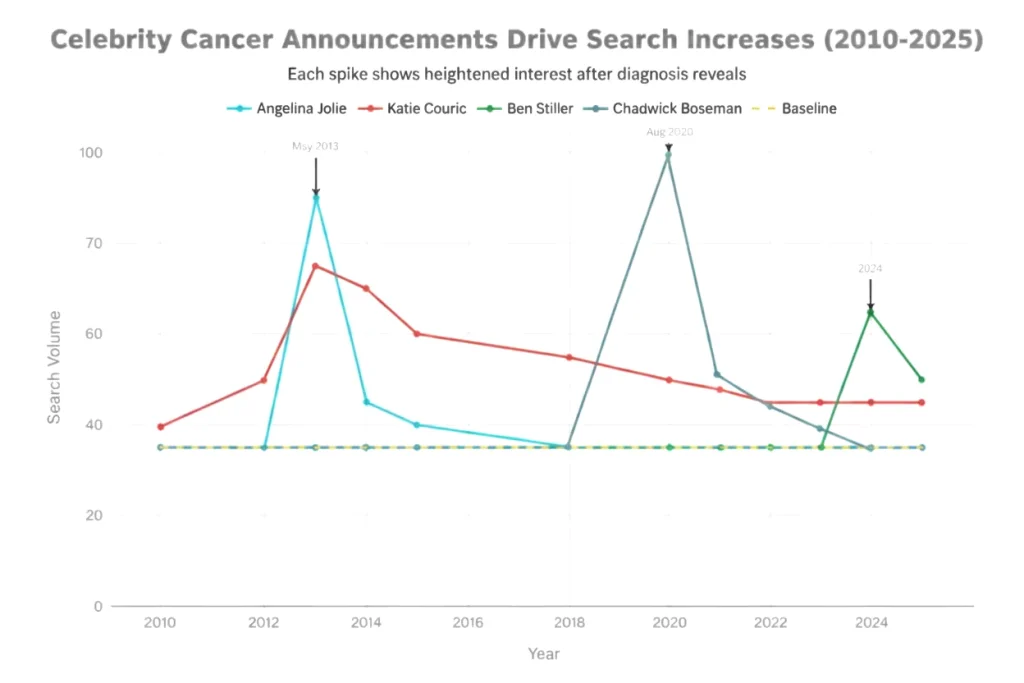
- The “Angelina Effect”: Celebrity health announcements actually work. They drive millions of us to get checked.
- Your takeaway: Know your risk, book your screenings, and be your own best health advocate.
Dr. Omid Modiramani
Medical Oncologist & Hematologist · 12+ Years Experience
The Importance of Early Detection: Survival Rates & Facts
Why do regular checkups matter so much? Because cancer often grows silently before you feel a thing.
The stories of celebrities like Christina Applegate (diagnosed at 36) and Ben Stiller (diagnosed at 48) prove that catching it early is the ultimate survival hack. Here is why prioritizing detection is non-negotiable:
- It finds the invisible: Many cancers show zero symptoms early on. Stiller had no idea he was sick until a routine test found it.
- It drastically improves odds: The gap between early-stage and late-stage survival is massive (as you’ll see in the chart below).
- It enables less aggressive treatment: Catching it early often means avoiding harsh chemotherapy or major surgeries.
- It saves lives: Simply put, timing is the hero in every single one of these stories.
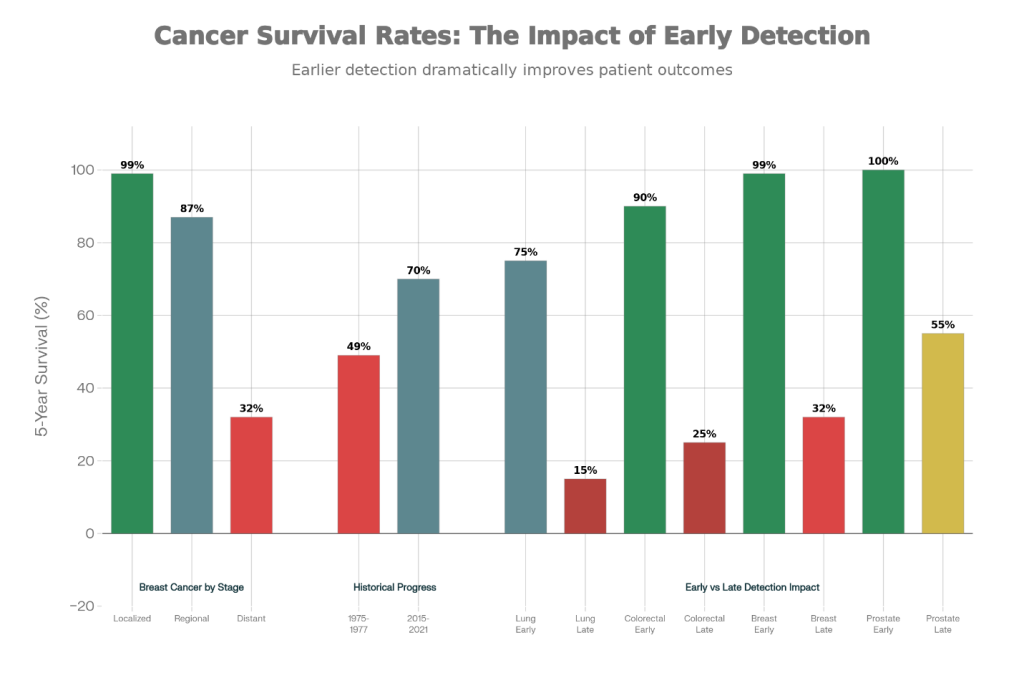
The numbers don’t lie. According to the U.S. Department of Health & Human Services, A woman diagnosed with localized breast cancer has a 99% chance of living at least 5 more years. But if that diagnosis waits until the cancer has spread? That survival rate crashes to 32%. This isn’t just a statistic on a chart; it represents years of life, time with family, and a future saved.
In the stories below, we move beyond the red carpet to reveal exactly how these stars caught it, whether through routine checks, lucky incidental findings, or proactive risk management. Let’s look at the roadmap they followed.

Total Body Rejuvenation & Longevity: AIC City Polyclinic
Breast Cancer Survivors: Detection Through Mammograms, MRIs & Incidental Findings
Breast cancer is common, but it’s also highly survivable when caught early. These female celebrities found it through everything from routine mammograms to gut feelings.
Christina Applegate: Why Family History Changes Everything

The Timeline: Routine mammogram at 30 (due to family history) → MRI screening → Diagnosis at 36 → Double mastectomy + BRCA1 testing.
Christina didn’t wait for the “standard” screening age of 40. Because of her family history, she started in her 30s. “I was at a higher risk,” the celebrity explained. That decision to start early, combining mammograms with MRIs (which are more sensitive), caught her cancer before it spread. She also tested positive for the BRCA1 gene, leading her to choose a preventive double mastectomy.
Key Lesson: Family history isn’t just a note in your file; it’s an action plan. If cancer runs in your family, don’t wait for the standard age guidelines.
Robin Roberts: The Power of Self-Awareness

The Timeline: Self-exam finds lump at 46 → Ultrasound/Biopsy → Treatment → Full recovery.
Robin’s discovery didn’t happen at a doctor’s office; it happened at home. The celebrity anchor felt a lump during a self-exam. Despite it being an aggressive type (triple-negative), catching it early meant she could opt for a lumpectomy rather than a full mastectomy.
Key Lesson: You know your body best. 40% of breast cancers are found via self-exams. Feel something weird? Check it out immediately.
Sheryl Crow: The Mammogram She Almost Skipped

The Timeline: Routine mammogram at 44 → DCIS diagnosed → Lumpectomy + Radiation.
Sheryl almost cancelled her appointment because she was “too busy.” Going anyway saved her life. The mammogram found DCIS (“stage zero” cancer). Because the celebrity caught it at the pre-cancerous stage, she avoided invasive cancer entirely.
Key Lesson: Don’t skip the appointment. Put it in your calendar in pen, not pencil.
Cynthia Nixon: Routine Screening, Perfect Timing

The Timeline: Routine mammogram at 40 → Stage 1 detected → Lumpectomy.
Cynthia followed the rules: she went for her routine mammogram at 40. It worked exactly as intended, finding a Stage 1 tumor before she had any symptoms.
Key Lesson: The guidelines exist for a reason. Routine screening at 40 creates a safety net.
Hoda Kotb: The Clinical Exam That Mammograms Missed

The Timeline: Gynecologist exam → Doctor feels lump → Ultrasound confirms cancer.
Here’s a scary truth: Mammograms don’t catch everything. Hoda’s cancer was found by her gynecologist during a physical exam, not a scan. This is crucial for women with dense breast tissue, where mammograms can sometimes struggle to see clearly.
Key Lesson: Technology is great, but physical exams still matter. Use both.
Wanda Sykes: The Cancer Found During Elective Surgery

The Timeline: Breast reduction surgery planned → Surgeon finds DCIS → Double mastectomy.
Wanda went in for a cosmetic breast reduction, not a cancer screening. The pathology report on the removed tissue came back with Stage 0 cancer. It was a complete shock, or what doctors call an “incidental finding.” The celebrity comedian opted for a double mastectomy to be safe.
Key Lesson: Medical procedures often have hidden benefits. Always request pathology reports on removed tissue.
Olivia Munn: When Risk Calculators & MRI Catch What Mammograms Miss

The Timeline: Normal mammogram → Risk Score calculated (37% high risk) → MRI ordered → Cancer found.
This is a modern screening success story. Olivia’s mammogram was clear. But her doctor calculated her “Lifetime Risk Score,” saw it was high (37%), and ordered an MRI. The MRI found the aggressive cancer that the mammogram missed.
Key Lesson: Ask your doctor about your “Risk Score.” If it’s high, a mammogram might not be enough; you might need an MRI.
Rita Wilson: Invasive Lobular Carcinoma Caught Early

The Timeline: Routine screening → Invasive Lobular Carcinoma (ILC) diagnosis → Treatment.
Rita had a specific type of cancer (ILC) that hides well on mammograms. However, diligent screening and follow-up caught it early, allowing the celebrity to make a full recovery.
Key Lesson: Not all breast cancers look the same. Consistent screening increases the odds of catching the tricky ones.
Linda Evangelista: Two-Time Survivor & Screening Advocate

The Timeline: Diagnosed twice → Survived both → Advocates with “mammogram selfies.”
Linda has beaten breast cancer twice. The supermodel celebrity is famous for posting photos of her mammogram to normalize the process. Her persistence shows that screening isn’t a “one-and-done” deal; it’s a lifelong commitment.
Key Lesson: If you’ve had cancer, your watch never ends. continued surveillance is key.
Kathy Bates: Multiple Cancer Survivor

The Timeline: Ovarian cancer (2003) → Breast cancer (2012) → Full recovery.
Kathy beat ovarian cancer, then years later, beat breast cancer. She doesn’t have the BRCA gene, proving that cancer can strike any celebrity or person, regardless of genetics. Her vigilance with her health team caught the second cancer early.
Key Lesson: Surviving one cancer means you need to stay alert for others.
Olivia Newton-John: Pioneering Survivor (1992–2022)

The Timeline: Diagnosed 1992 → 30+ years of life and advocacy.
While the world lost Olivia in 2022, she lived (and thrived) for 30 years after her initial diagnosis. That is the gift of early detection and treatment: decades of life, love, and career.
Key Lesson: Early detection buys you time. In Olivia’s case, it bought 30 wonderful years.
Prostate Cancer Survivors: The Power of Routine Checkups
Men often skip the doctor, but these male celebrities didn’t. Routine physicals and simple blood tests (PSA) made all the difference.
Ben Stiller: The Annual Exam That Caught It Early

The Timeline: Physical at 46 (PSA test included) → Diagnosis at 48 → Surgery → Cure.
Ben had no symptoms. No family history. But his doctor threw in a PSA blood test during his annual physical. It showed rising numbers. They tracked it, found the cancer early, and removed it. Ben says bluntly, “This test saved my life.”
Key Lesson: Get an annual physical. Ask for a PSA test baseline, even if you’re under 50.
Colin Powell: Detection During Public Service

The Timeline: Diagnosed 2003 via routine checkup → Surgery → Recovery.
Even while running the State Department, Powell kept his medical appointments. His prostate cancer was found early, treated efficiently, and the celebrity statesman was back to work quickly.
Key Lesson: You are never “too busy” for a checkup.
Robert De Niro: Regular Checkups Pay Off

The Timeline: Routine checkup 2003 → Early diagnosis → Full recovery.
Like Powell, De Niro’s cancer was a blip on the radar because regular checkups caught it before it became a crisis.
Key Lesson: Routine maintenance works for cars, and it works for bodies.
Arnold Palmer: Advocacy Beyond Diagnosis

The Timeline: Diagnosed 1997 → Surgery/Radiation → Legacy of advocacy.
The golf legend celeb didn’t just survive; he started a center to help others. His early diagnosis allowed him to leverage his fame to save other men.
Key Lesson: Early detection allows you to turn a diagnosis into a legacy.
Colorectal Cancer Survivors: The Colonoscopy Success Stories
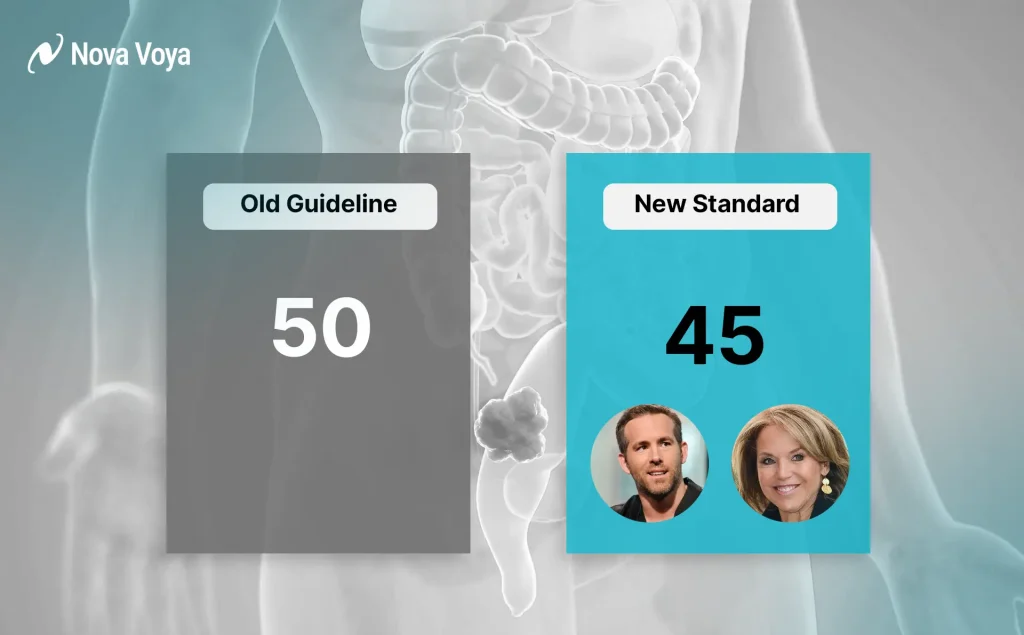
Colon cancer is unique because screening can actually prevent it by removing polyps before they turn into cancer.
Morgan Freeman: Stage 1 Detection at 73

The Timeline: Diagnosed Stage 1 → Surgery → No Chemo needed.
Morgan Freeman was 73, proving you’re never too old to screen. Because it was Stage 1, he avoided chemotherapy entirely.
Key Lesson: Screening works at any age.
Katie Couric: The “Couric Effect”
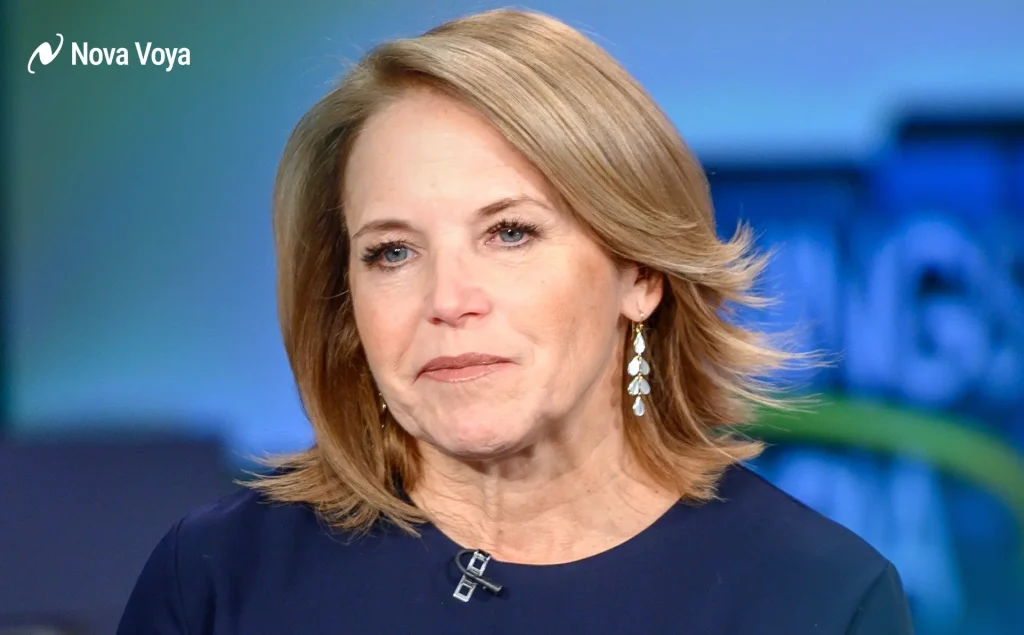
The Timeline: Husband died of colon cancer → She televised her own colonoscopy → Found/Removed precancerous polyps.
Katie turned her grief into action. She got a colonoscopy on live TV, and doctors actually found (and removed) precancerous polyps right there. She didn’t just save her own life; colonoscopy rates nationwide jumped 20% after her broadcast, a phenomenon known as the “Katie Couric Effect” or “Celebrity Effect.”
Key Lesson: Colonoscopies prevent cancer. Just get it done.
Ruth Bader Ginsburg: Long-Term Survivor
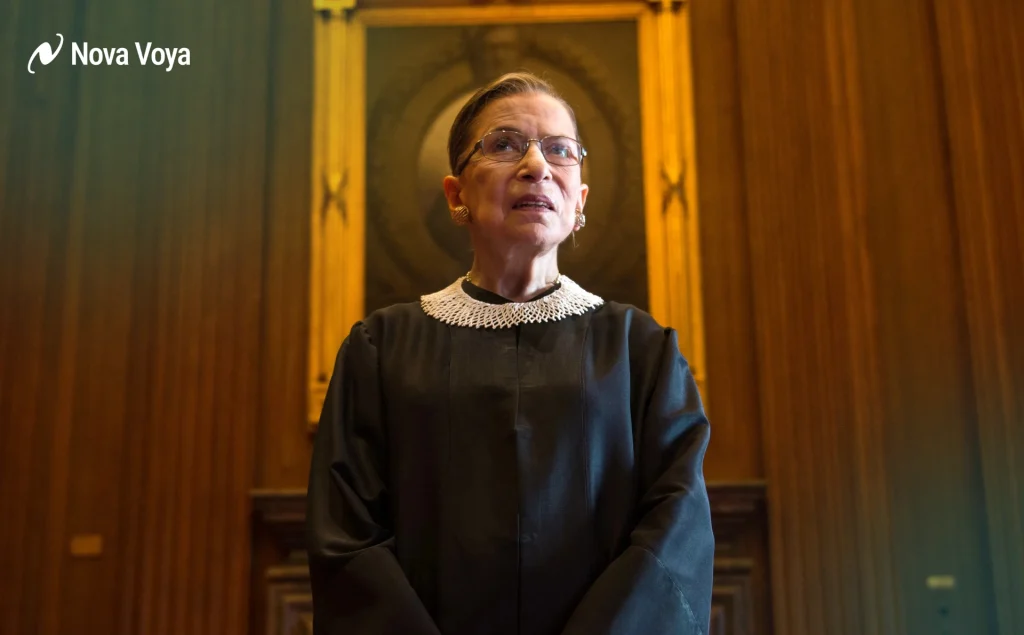
The Timeline: Diagnosed 1999 → Treated → Served 21 more years on the Supreme Court.
RBG fought many health battles, but beating colon cancer in 1999 gave her 20+ more years on the bench.
Key Lesson: Early detection protects your future and your career.

Essential Health Screening: Shiraz Medical Center

Comprehensive Health Screening for Men Above 40 Years: Shiraz Medical Center
Skin Cancer Survivors: Early Detection Every 3 Months
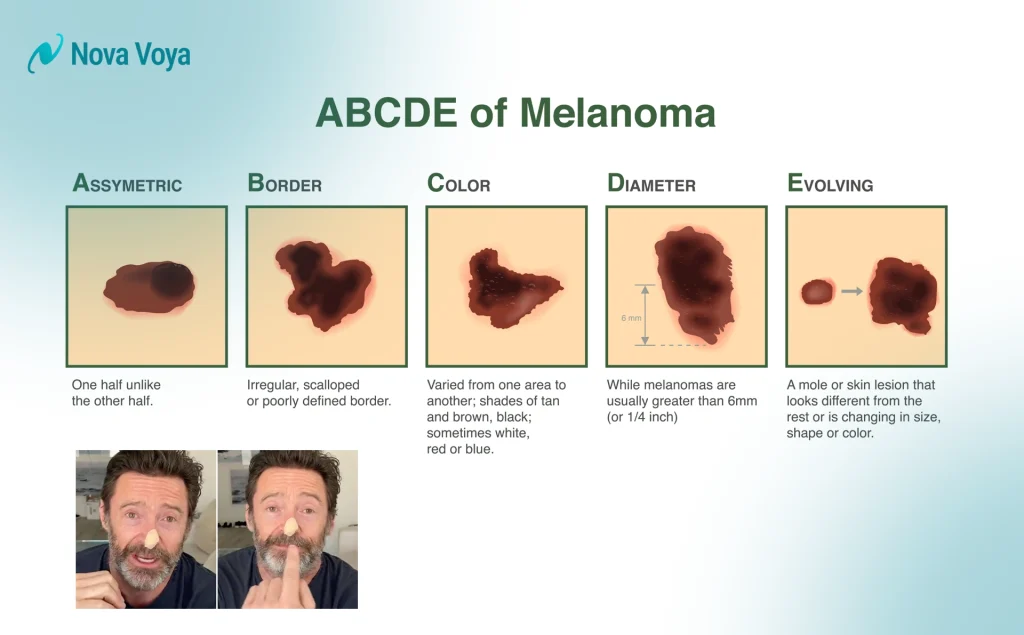
Skin cancer is often considered the “easiest” cancer to detect because it happens right on the surface of your skin. However, that visibility can be deceptive. Types like melanoma are notoriously fast-moving and can spread to other organs if ignored for even a few months. That is why regular checks are non-negotiable.
Hugh Jackman: The Frequent Flyer
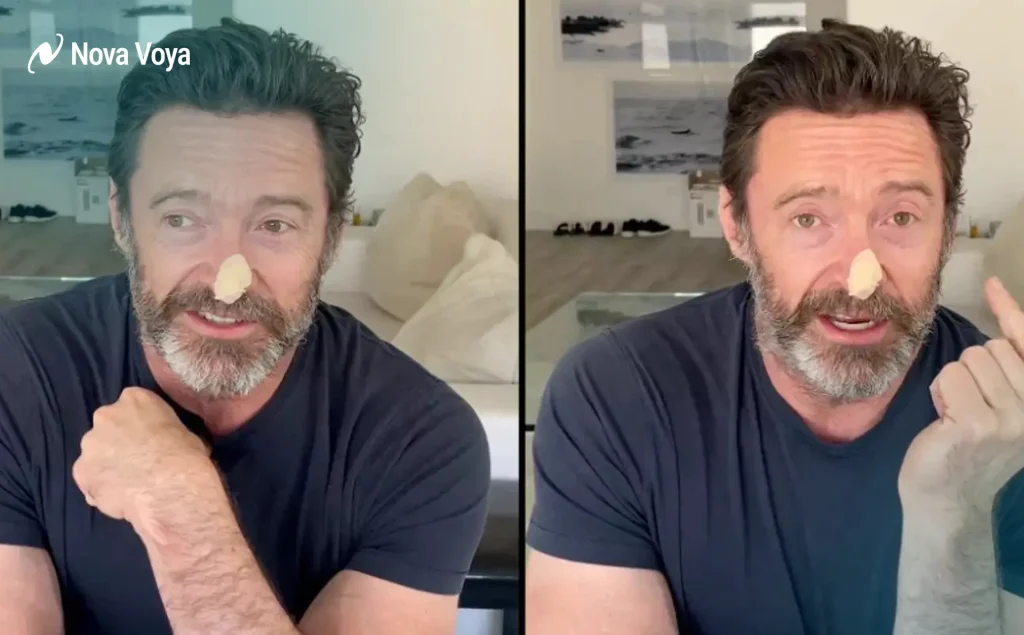
The Timeline: Basal cell carcinoma on nose → Checks every 3 months.
Wolverine is tough, but the sun is tougher. This celebrity gets checked every 3 months because he keeps developing skin cancers. His vigilance keeps them from becoming dangerous.
Key Lesson: If you have high sun exposure, an annual check might not be enough. Go quarterly.
President Jimmy Carter: Melanoma with Rapid Spread

The Timeline: Melanoma at age 90 spread to the brain → Immunotherapy → Remission.
Even at 90, with cancer spread to his brain, Jimmy Carter survived thanks to modern Immunotherapy. It’s a testament to never giving up.
Key Lesson: Modern medicine is a miracle. Even advanced skin cancer is beatable now.
Other Cancer Types: Pancreatic, Brain & Lymphoma
These are the tricky ones. They often don’t have standard screening tests, so listening to your body is everything.
Maria Menounos: Thinking Beyond Guidelines

The Timeline: Pain → Doctors dismissed it → Self-paid Full Body MRI → Tumor found.
Maria is the poster child for “be your own celebrity advocate.” Doctors dismissed her pain. She paid for a Prenuvo full-body MRI herself. It found a pancreatic tumor. Catching pancreatic cancer at Stage 2 is incredibly rare and lucky.
Key Lesson: If you know something is wrong, keep pushing. Consider advanced imaging if standard tests show nothing.
Mark Ruffalo: The Intuitive Diagnosis
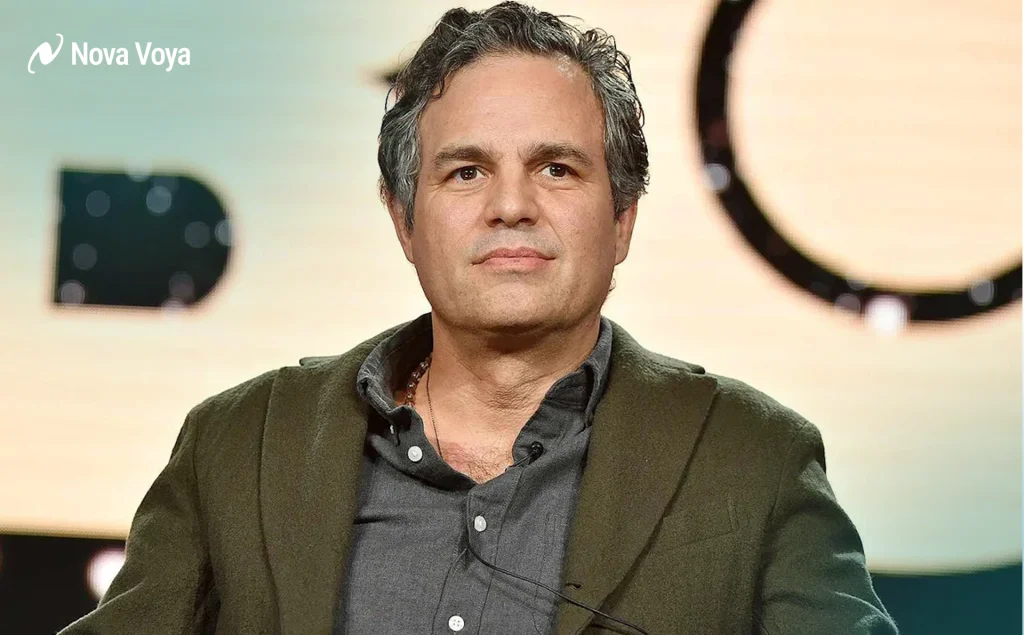
The Timeline: Vivid dream about brain tumor → Went to doctor → Tumor confirmed.
This sounds like a movie script, but Mark literally had a dream that he had a brain tumor. He felt “off.” He went to the doctor, and they found it.
Key Lesson: Don’t ignore your intuition. If your brain is telling you something is wrong, listen.
Sharon Jones: Pancreatic Cancer Survival

The Timeline: Diagnosed early enough for surgery → Returned to stage.
Pancreatic cancer is usually fatal quickly. Sharon caught hers early enough to operate, buying the celebrity singer years of performing.
Key Lesson: Early action buys quality time.
Michael C. Hall: Working Through It

The Timeline: Hodgkin’s lymphoma → Treated during Dexter → Remission.
He kept his diagnosis quiet and worked through it. Because it was caught early, it was highly treatable.
Key Lesson: Cancer doesn’t always have to stop your life in its tracks.
Dave Coulier: The 90% Curability Rate

The Timeline: Stage 3 Lymphoma (2024) → “90% curable” prognosis.
“Uncle Joey” faced a scary Stage 3 diagnosis, but his doctors told him it was 90% curable because of the type and timing.
Key Lesson: “Stage 3” sounds scary, but modern treatments are incredibly effective for Lymphoma.
Incidental Findings: The “Lucky” Diagnosis
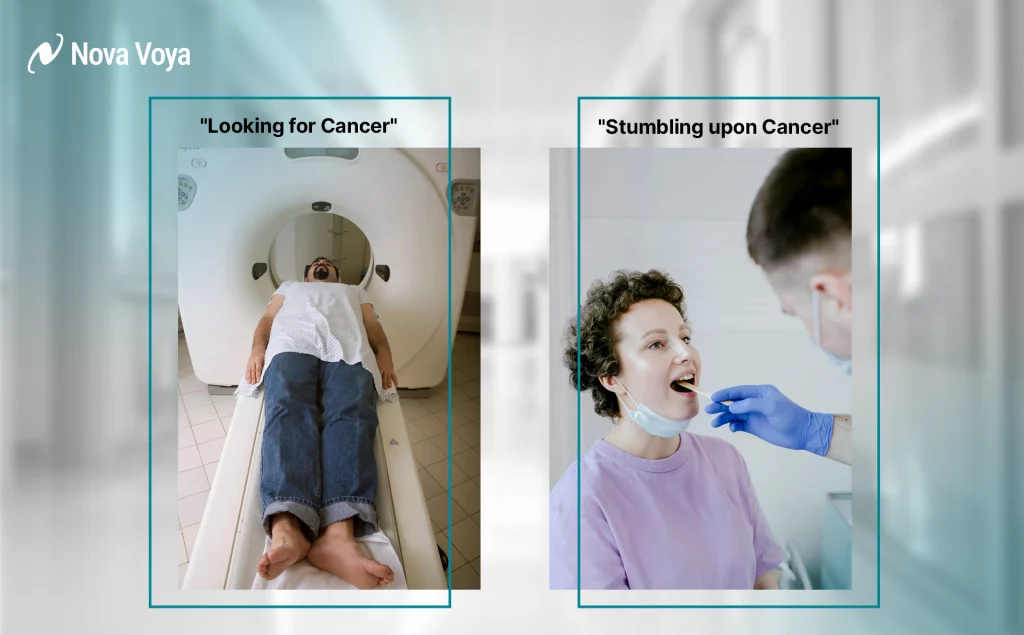
Sometimes, you get lucky. An “incidental finding” is when doctors find cancer while looking for something else.
- Wanda Sykes: Found during breast reduction.
- Maria Menounos: Found during an elective MRI.
- Tarek El Moussa: A fan watching this celebrity’s TV show noticed a lump on his neck!
The Lesson: Every medical appointment, every scan, and even keen observations from others can be a lifesaver. Never dismiss an abnormality.
Cancer Screening Guidelines: Your Cheat Sheet
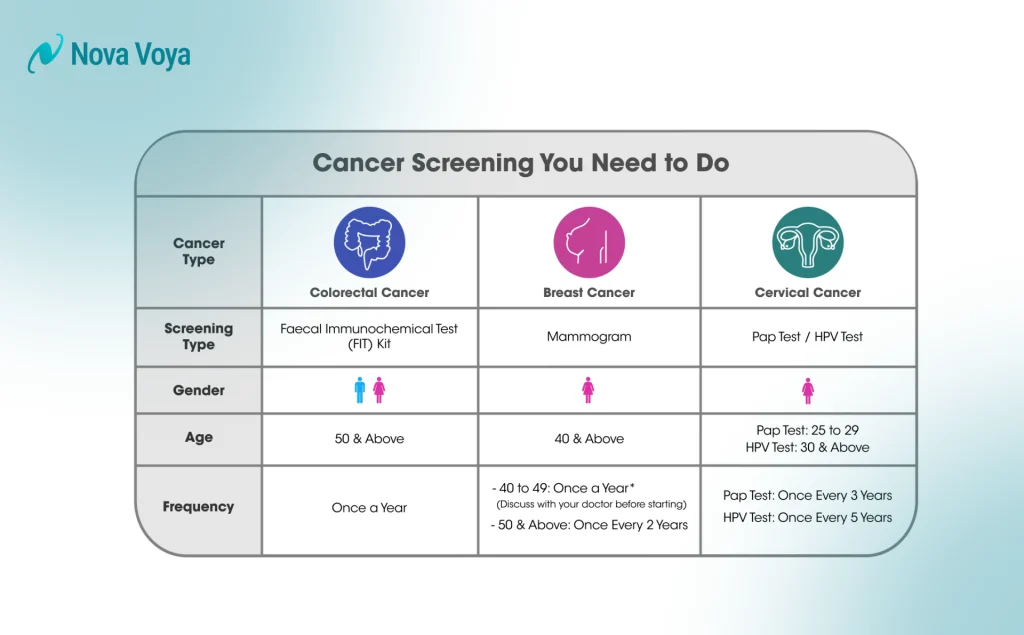
Here is the simple version of when you need to book an appointment (based on current ACS and USPSTF guidelines).
- Breast:
- 40-44: Optional start.
- 45-54: Annual mammogram (Must do).
- 55+: Every 1 or 2 years.
- Prostate:
- 45: Talk to your doc if you’re African American or have family history.
- 50: Talk to your doc if you’re average risk.
- Colorectal (The Big Change):
- 45: Everyone starts here now! (It used to be 50).
- Lung:
- 50-80: If you have a 20+ year smoking history.
- Skin:
- Any age: Check yourself monthly. See a derm yearly.
Key Takeaways: What We Learned
- Family History is King: If your mom/dad had it, you need to screen 10 years earlier than they were diagnosed.
- Self-Awareness Works: 40% of breast cancers are found by the patient, not the doctor.
- One Test Isn’t Enough: Dense breasts? Ask for an ultrasound and a mammogram.
- Routine = Survival: Don’t skip the annual physical.
- Be Like Maria: If you have symptoms and doctors say “you’re fine,” push for more testing.
Actionable Next Steps: Your Personal Plan
Don’t just read this and close the tab. Do these 4 things today:
- Check Your Age: Are you 45? Call a GI doctor for a colonoscopy. Are you 40 (female)? Schedule the mammogram.
- Quiz Your Parents: Ask: “Who in our family had cancer and exactly how old were they?”
- Put it in the Calendar: Set a recurring reminder in your phone for “Annual Physical.”
- Listen to Your Gut: If something feels off for more than 2 weeks, go to the doctor.
Take Action Today!
You now know 25+ celebrity survivors. The question is: Will you use it?
Your first step: Open your calendar app right now. Schedule that physical you’ve been putting off.
Ready to Start Your Journey in Dubai? 🏥
- ✔ DHA-verified clinics and licensed physicians only
- ✔ Transparent pricing on packages from health screenings to full longevity programs
- ✔ Easy online booking for procedures across Dubai’s leading regenerative clinics
*Verified Clinics Only
Disclaimer: This article is for informational purposes only. Go see a real doctor for medical advice!
Frequently Asked Questions
It’s the difference between a “medical inconvenience” and a life-threatening battle. Early stage often means surgery only. Late stage usually means chemo, radiation, and lower survival odds.
When Angelina announced she had the BRCA gene and got preventive surgery, genetic testing referrals jumped 90%. It proves that sharing celebrity stories saves lives.
Sort of! You can opt for elective screenings (like full-body MRIs), though insurance rarely covers them. Otherwise, just being diligent with any medical symptoms increases your odds of finding things early.
Yes. Rates are rising in young people. Do not wait until 50.