
Ramadan is the ninth month of the Islamic calendar, observed by Muslims through fasting and extra prayer to commemorate the month in which the Quran was revealed. Because it follows a lunar calendar, Ramadan shifts earlier each year, and Eid al-Fitr begins after the next crescent moon sighting. Visiting Dubai during Ramadan can be one of the most memorable times to see the city; quieter days, lively nights, and a real sense of community. It also comes with a few rules and schedule changes that can catch travelers off guard. This guide covers respectful etiquette, dining expectations, and how to plan around reduced opening hours.
To ensure a seamless journey and discover the best care options available year-round, explore our comprehensive UAE Medical Travel Guide.
- TL;DR (Key Takeaways)
- What is Ramadan in Dubai, and why do dates change every year?
- Can tourists eat or drink in public during Ramadan in Dubai?
- A quick etiquette checklist for patients visiting Dubai during Ramadan
- What should I wear in Dubai during Ramadan?
- Will attractions be closed during Ramadan in Dubai?
- Is it safe to travel to Dubai during Ramadan?
- How do I plan a Dubai trip during Ramadan without missing out?
- Frequently Asked Questions
TL;DR (Key Takeaways)
- Ramadan is the ninth month of the Islamic calendar, marked by fasting, prayer, and community gatherings.
- In Dubai, many businesses and attractions stay open, but often with reduced or shifted hours.
- In public during daylight, eating, drinking, smoking, and even chewing gum can be seen as disrespectful and may lead to fines.
- Dress modestly in public spaces (shoulders and legs covered to at least the knees) to avoid unwanted attention or legal trouble.
- Many restaurants still serve daytime visitors by screening dining areas from public view; evenings center around iftar after sunset.
- Some experiences (like dinner cruises) may adjust timing so dining starts after sundown.
Looking for the Best Medical Packages? 🏥
Nova Voya secures exclusive packages just for our users.
- ✔ Direct Hospital Access: No middleman delays.
- ✔ Transparent Pricing: Know your costs upfront.
- ✔ Visa Assistance Included: Full support.
*Verified Clinics Only
What is Ramadan in Dubai, and why do dates change every year?
Ramadan in Dubai is a deeply spiritual and culturally vibrant month of fasting, prayer, and community, where the bustling city takes on a more reflective pace with shortened work hours, peaceful days, and lively evening Iftar gatherings to break the fast. The dates for this holy month change every year because the Islamic calendar is strictly lunar, relying on the physical sighting of the new moon. Since the lunar year is roughly 10 to 11 days shorter than the standard Gregorian solar calendar, Ramadan shifts backward annually, gradually cycling through all four seasons over 33 years.
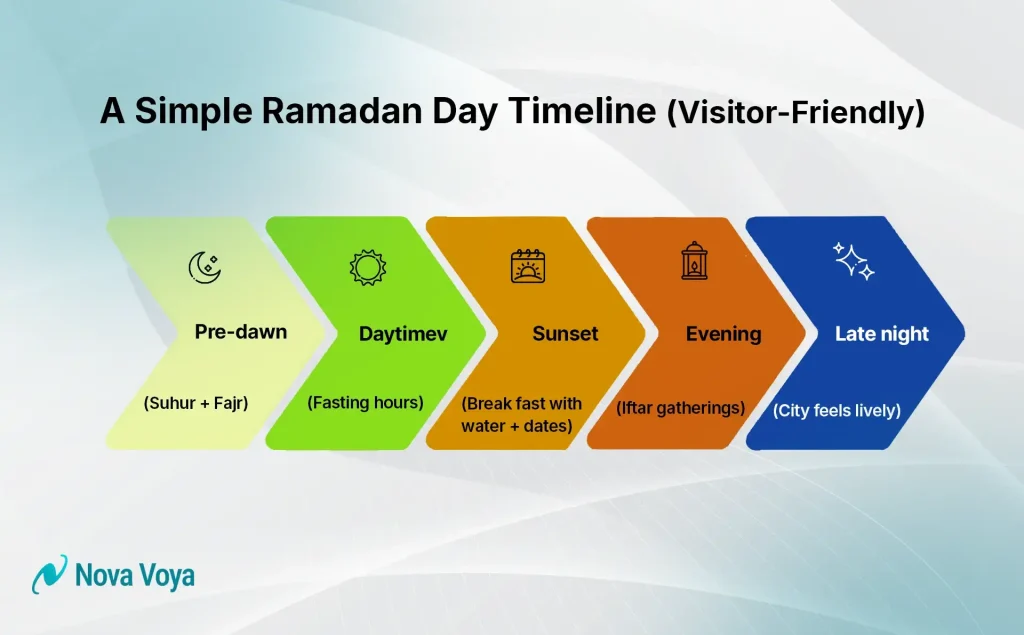
What a typical day can look like in Dubai during Ramadan
- Pre-dawn: Many people eat suhur (the pre-dawn meal) before the first prayer of the day.
- Daytime: Observant Muslims fast from sunrise to sunset, also avoiding smoking and negative behavior.
- Sunset: The fast is broken, traditionally with water and dates, followed by iftar, often a larger meal shared with family and friends.
Can tourists eat or drink in public during Ramadan in Dubai?
In Dubai during Ramadan, non-Muslims are expected to avoid eating, drinking, smoking, or chewing gum in public during daylight hours out of respect for those fasting. Restaurants may still serve visitors during the day, often by screening dining areas from public view, and evenings are centered around iftar after sunset.
This is one of the most important “don’t get fined” topics for visitors.
“public” usually means
- Streets, malls, queues, and public-facing areas
- Public transport and stations
- Outdoor promenades and attractions
What you can do instead
- Eat in venues that are operating for non-fasting guests (often with blinds or partitions)
- Plan snacks and hydration for private spaces (hotel room, designated dining areas)
- Shift your “big meal” to the evening and enjoy the city’s nighttime energy
A quick etiquette checklist for patients visiting Dubai during Ramadan
| Situation in Dubai during Ramadan | Safer choice for tourists | Why it matters |
| Thirsty while walking outside | Drink in a private area | Public drinking can be seen as disrespectful |
| Want a daytime coffee | Use a screened café/restaurant | Many venues operate discreetly |
| Smoking/vaping | Avoid in public during fasting hours | Public smoking is part of the etiquette restrictions |
| Chewing gum | Skip it in public | It counts as eating in public |
Note: Failing to respect Ramadan etiquette can lead to legal consequences such as a fine. If you’re unsure, choose the more discreet option.
What should I wear in Dubai during Ramadan?
During Ramadan in Dubai, both men and women are expected to dress more modestly in public, covering their shoulders and legs down to at least the knees. This is less about fashion and more about respect, since Ramadan is a religious month and etiquette expectations are taken seriously.
Easy outfit rules that work for most tourists are:
- Tops that cover shoulders (short sleeves are often fine if not too revealing)
- Bottoms that reach at least the knees (longer is usually easier)
- Lightweight fabrics (Dubai can still feel warm)
For more information, you can read our article about “Cultural Etiquette in UAE“
Where modest dress matters most
- Public areas during the day
- Government buildings and more traditional neighborhoods
- Any religious or cultural sites
If you already dress modestly, you probably won’t change much. If you usually wear very short or very revealing outfits, packing one or two “coverage” options can save you stress.
Will attractions be closed during Ramadan in Dubai?
Most major attractions in Dubai still operate during Ramadan, but many use reduced or adjusted opening hours. The biggest difference is timing; some experiences shift later, so activities like dining start after sundown, and you’ll need to plan your day more carefully than usual.
The UAE isn’t “shut down” for tourism during Ramadan. It just runs on a different rhythm.
Examples of experiences that may be affected by Ramadan timing are:
- Dinner cruises may adjust schedules so dining starts after sunset.
- Some restaurants may be closed during the day and open at night for iftar.
- Many attractions remain open, but with shorter hours.
Is it safe to travel to Dubai during Ramadan?
Dubai is generally a well-organized destination for visitors during Ramadan, but evenings can bring larger crowds around iftar. The extra awareness is advised because crowded gatherings can be targets for extremists, and officials may expect increased attacks during Ramadan. Staying alert in busy areas is a sensible travel habit.
This doesn’t mean you should avoid Ramadan travel. It means you should travel smart.
Practical safety habits for busy iftar times are:
- Keep your belongings close in crowded areas
- Know your route back to your hotel before heading out
- If a location feels overly packed, step away and choose a calmer spot
If you’re traveling for medical care, planning matters even more, including appointment timing, transport, and rest. Nova Voya can help you coordinate a schedule that fits the Ramadan rhythm through our care coordination (without you having to juggle every detail yourself).
How do I plan a Dubai trip during Ramadan without missing out?
A good Ramadan plan in Dubai is simple: keep daytime flexible, confirm reduced opening hours, and treat evenings as the main event. Many attractions remain available, but you’ll get a smoother trip by scheduling key activities later in the day and leaving space around sunset for traffic and crowds.
A visitor-friendly Ramadan day plan (sample)
- Morning: Low-key activities (hotel breakfast if available, indoor sightseeing)
- Midday: Rest, spa time, shopping in air-conditioned malls (with etiquette in mind)
- Late afternoon: Attractions that are open (confirm hours first)
- Sunset + evening: Iftar dining, waterfront walks, night views
If you’re combining travel with treatment
Ramadan can shift clinic and pharmacy hours too (depending on facility policies). If your trip has medical appointments, aim for:
- Earlier confirmation of schedules
- Extra time for transport
- A recovery-friendly evening plan (quiet, hydration in private, good sleep)
Seeking World-Class Medical Care in Dubai? 🏥
Nova Voya helps international patients seamlessly navigate advanced healthcare in Dubai. We connect you with top-tier medical specialists and accredited hospitals tailored precisely to your unique healthcare needs, ensuring a smooth, safe, and stress-free medical journey.
- ✔ Personalized matching with leading medical experts and premier facilities
- ✔ Full support with medical coordination, second opinions, and logistics
- ✔ Independent, honest guidance focused entirely on your health goals
*Medical tourism guidance, not clinical advice
Frequently Asked Questions
Non-Muslims are not required to fast, but they are expected to respect those who are fasting by avoiding eating, drinking, smoking, or chewing gum in public during daylight hours. Many venues still serve visitors during the day using blinds or partitions.
Some restaurants remain open in daylight for visitors and non-observers, often screening diners from public view. Many other venues open after sunset and may offer iftar meals in the evening.
Many attractions remain open, but reduced or adjusted opening hours are common. Checking hours before you go is important, especially for experiences that include dining, since schedules may shift to start after sundown.
Iftar is the meal eaten after sunset to break the fast. The traditional breakfast practice of water followed by dates, often followed by a larger meal shared with family and community.
Yes. Dubai and Abu Dhabi are not completely closed to tourism during Ramadan, but visitors should expect reduced hours and plan ahead.
both men and women should cover shoulders and legs (at least to the knees) in public. Modest, lightweight clothing usually makes the trip easier and helps you avoid unwanted attention or legal issues.
Ready to start? Book your Free Consultation with Nova Voya today.
Are you visitiDubai During Ramadanng during Ramadan for sightseeing, for a medical trip, or both, and what part of planning feels most uncertain right now?