

Studies show that over 60% of postmenopausal women experience vaginal dryness, and nearly half report burning or irritation. After vaginal delivery, around one in three women experiences some degree of urinary leakage in the first three months.
The good news? There’s a fast, non-surgical option available in Dubai that’s backed by a growing body of clinical research: laser vaginal rejuvenation.
This guide covers everything you need to know: how it works, who it’s for, what the experience is like, and how to find the right clinic.
- Key Takeaways: (TL;DR)
- Why Laser and Not Surgery?
- Laser vs. Vaginoplasty: The Side-by-Side Comparison of two treatments
- Is laser vaginal rejuvenation Right for You?
- CO₂ vs. Er:YAG Lasers for Vaginal Rejuvenation: Key Differences Explained
- Rejuvenation Laser vs. Bleaching Laser: What's the Difference?
- What to Expect from Laser Vaginal Rejuvenation
- How to Choose the Right Clinic in Dubai for Laser vaginal rejuvenation
- Common Myths About Laser Vaginal Rejuvenation in Dubai
- Summary
- FAQs
Key Takeaways: (TL;DR)
- Laser vaginal rejuvenation is a non-surgical, minimally invasive treatment that stimulates your body’s own collagen production from the inside out.
- It addresses common concerns like dryness, laxity, burning, and discomfort, without general anesthesia, stitches, or significant downtime.
- Two main laser types are used: the fractional CO2 laser and the Er:YAG laser, each with slightly different strengths.
- Women after childbirth, those in perimenopause or menopause, and cancer survivors who can’t use hormonal therapy are among the strongest candidates.
- Side effects are typically mild and temporary, the most commonly reported is light vaginal discharge, which clears on its own.
- Results have been shown to persist at 12-month follow-up in clinical studies, though individual outcomes vary.
- Dubai clinics like NewSense Clinic and Roya Medical Center offer this treatment with specialist gynecologists and advanced technology.

Why Laser and Not Surgery?
Laser vaginal rejuvenation works by delivering focused light energy to vaginal tissue, triggering a controlled healing response in your body. The laser creates mild, precise thermal stimulation in the deeper tissue layers, enough to activate what researchers call heat shock proteins. These proteins switch on a signaling process that ultimately produces new collagen and elastic fibers.
The result? Tissue that’s thicker, better hydrated, and firmer; without cutting, stitching, or recovery rooms.
Here’s why so many women are choosing laser over surgery:
- No general anesthesia required. The procedure is performed in a clinical setting without the risks associated with sedation.
- No stitches, no scars. Laser energy works beneath the surface. Nothing is cut.
- Minimal downtime. Most women return to their daily routine quickly, with no need for the weeks of recovery that surgical options demand.
- Hormone-free. For women who can’t use estrogen-based therapies, including breast cancer survivors, laser offers a safe, non-hormonal path to symptom relief.
- Versatile. The same treatment can address laxity, dryness, urinary leakage, and tissue changes related to menopause or childbirth, often in the same course of sessions.
Laser vs. Vaginoplasty: The Side-by-Side Comparison of two treatments
Before committing to any treatment, it helps to understand exactly what separates laser rejuvenation from surgical vaginoplasty.
Laser therapy isn’t a replacement for every surgical case, but for women seeking meaningful improvement without going under the knife, clinical evidence shows it delivers.
| Feature | Laser Vaginal Rejuvenation | Vaginoplasty (Surgical) |
| Anesthesia | Not required | General or regional anesthesia |
| Incisions & Stitches | None | Yes |
| Procedure Setting | Outpatient clinic | Operating theatre |
| Downtime | Minimal | Several weeks |
| Risk of Complications | Low; mostly mild, temporary | Higher; includes infection, scarring |
| Hormones Used | None | None |
| Suitable for Cancer Survivors | Yes (hormone-free) | Depends on case |
| Number of Treatment Sessions | Typically multiple sessions | One-time procedure |
| Result Timeline | Gradual improvement over weeks | Immediate structural change |
Is laser vaginal rejuvenation Right for You?
Laser vaginal rejuvenation covers a wide range of women’s concerns. Based on clinical research, it has shown the strongest results in:
Women after childbirth
Vaginal delivery can stretch and weaken pelvic tissues, sometimes permanently. Studies show that women who’ve given birth vaginally are twice as likely to experience urinary leakage compared to those who had caesarean sections.
Laser therapy has been studied specifically for postpartum tissue recovery, with results showing improvements in vaginal health markers and sexual function.
Women in perimenopause and menopause
Estrogen decline, which can start as early as your early 40s, leads to what clinicians call genitourinary syndrome of menopause (GSM): dryness, burning, itching, pain during sex, and increased urinary urgency.
Research shows that nearly half of postmenopausal women experience burning or irritation. Laser therapy directly targets these tissue changes by stimulating the body’s natural repair process.
Women who can’t use hormonal therapy
Breast cancer survivors, endometrial cancer patients, and others who are advised against estrogen-based treatments often have very limited options for GSM and vaginal atrophy. Clinical literature identifies laser therapy as a hormone-free alternative that has shown clinical benefit in exactly this group.
Women seeking general intimate rejuvenation
Even without a specific medical condition, some women notice changes in elasticity, sensitivity, or appearance over time and want to address them. Laser rejuvenation is increasingly used for these aesthetic and functional concerns as well.

Dr. Kubra Zengin Altintas
Functional & Aesthetic Gynaecologist · 13+ Years Experience
CO₂ vs. Er:YAG Lasers for Vaginal Rejuvenation: Key Differences Explained
Two primary technologies are used in aesthetic gynecology, and understanding their differences helps you ask the right questions when consulting a specialist.
Fractional CO2 Laser
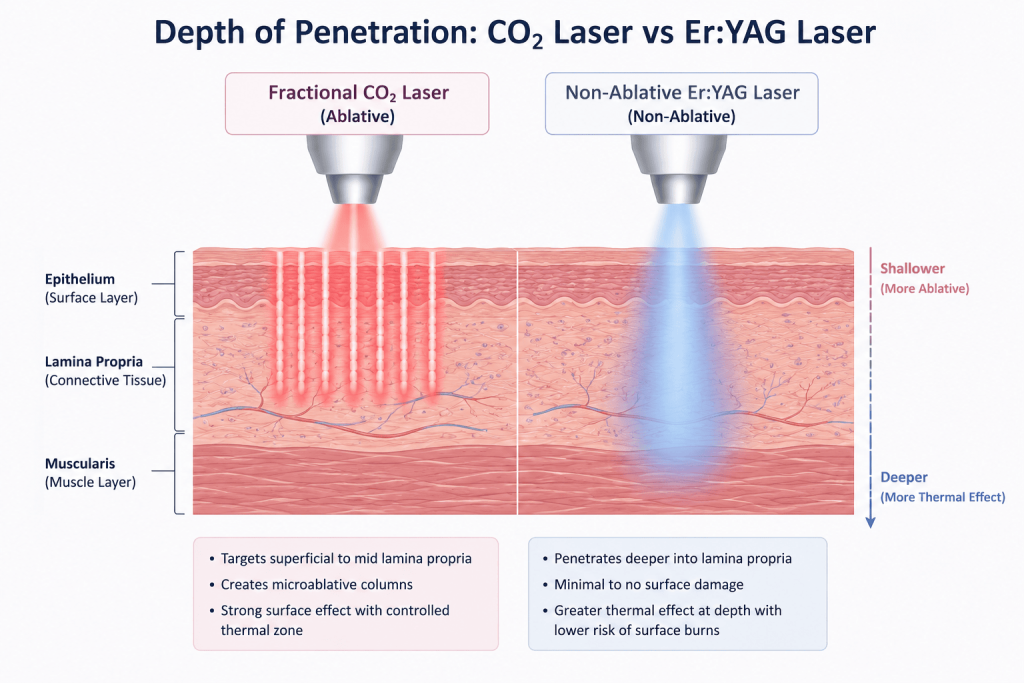
The CO2 laser works by using the heat generated from vaporizing water molecules in the deeper layers of vaginal tissue, specifically the lamina propria. This energy is carefully targeted to minimize damage to surrounding areas. The result is controlled stimulation of the tissue’s repair cycle, leading to new collagen production and improved structure.
CO2 laser has been extensively studied for stress urinary incontinence (SUI), vulvar white lesions, and genitourinary syndrome of menopause. A meta-analysis of 16 studies involving 899 women found that CO2 laser significantly improved outcomes on standardized incontinence and quality-of-life questionnaires at 1, 3, and 12 months post-treatment.
Non-Ablative Er:YAG Laser
The Er:YAG laser takes a gentler approach, it heats the deeper layers of vaginal mucosa while deliberately avoiding excessive heat at the surface. Research shows that Er:YAG lasers absorb water 10 to 15 times more efficiently than CO2 lasers, which allows them to deliver a deeper thermal effect while lowering the risk of surface burns.
Histological studies show that Er:YAG use increases vaginal epithelial thickness, density, and blood vessel count (all markers of healthier, more resilient tissue) without signs of inflammation.
Which One Is Better for You?
Your specialist will recommend the right device based on your specific symptoms and goals.
| Goal | Stronger Evidence For |
| Stress urinary incontinence | CO2 laser |
| Vaginal dryness & atrophy | Both CO2 and Er:YAG |
| Lichen sclerosus (chronic skin condition) | CO2 laser (also Er:YAG) |
| Gentle surface-preserving treatment | Er:YAG |
| Vulvar white lesions | CO2 laser |
| Post-childbirth tissue recovery | Both |
Rejuvenation Laser vs. Bleaching Laser: What’s the Difference?
This is a question that comes up often in Dubai clinics, so it’s worth clarifying.
Rejuvenation lasers
CO2 and Er:YAG work on the deeper layers of vaginal and vulvar tissue. Their purpose is functional and structural: building collagen, improving elasticity, reducing dryness, and restoring tissue health. The effects are internal, not cosmetic in a surface sense.
Intimate area bleaching or lightening
Bleaching laser targets skin pigmentation on the external intimate area; the labia, inner thighs, or perianal area. This is a separate treatment with different technology and a different goal: it’s about color and surface appearance, not tissue function.
The two procedures address different concerns and are not interchangeable. Some patients choose both as part of a broader intimate wellness plan, but they are separate consultations, separate technologies, and separate outcomes.
A qualified aesthetic gynecologist will assess your goals and explain which, if either, or both, applies to your situation.
What to Expect from Laser Vaginal Rejuvenation
How Long Is Each Session?
It varies, depending on the laser type, treatment area, and the specific condition being addressed. Your clinic will give you a precise time estimate during your consultation. Generally, these are short outpatient appointments.
Does It Hurt?
Clinical evidence consistently shows that laser vaginal rejuvenation is generally well tolerated. Patients may experience a mild, temporary burning sensation during the procedure, which typically resolves within a few hours. Reported discomfort levels remain low, and procedures are rarely, if ever, interrupted due to pain.
The treatment is performed without general anesthesia, further reflecting its minimal invasiveness and overall comfort profile.
How Many Sessions Do You Need?
Session numbers varied across the studies reviewed. Some trials used three sessions spaced at intervals; others evaluated outcomes after a single session. Results for stress urinary incontinence were evaluated at 1, 3, and 12 months in multi-session protocols.
Your specialist will recommend a course based on your condition and the device used.
Will You See Results Right Away?
Laser rejuvenation works by activating your body’s collagen-building process, which unfolds over time. Research notes that tissue remodeling continues for approximately one month after treatment. Clinical studies measured meaningful improvements at 1 month, 3 months, and up to 12 months. Gradual, progressive improvement is what the evidence supports.
How Long Do Results Last?
One prospective study found significant improvements in vaginal health and sexual function scores at a 12-month follow-up. Another, noted that effects from a single maintenance session were clearly measurable at 3 months but had diminished by 6 months, suggesting that periodic maintenance treatments are part of a long-term plan.
The exact timing for a top-up session depends on the individual and the treatment protocol used. Your specialist will guide you based on your response.
What If You’re Planning Another Pregnancy?
This is an important question to raise directly with your specialist during your consultation. A qualified aesthetic gynecologist will review your personal situation and advise accordingly.
Are There Side Effects?
Side effects from laser therapy are mild and temporary. No serious adverse events were reported in any of the major studies reviewed. The most commonly reported side effect was vaginal discharge, noted in up to 88% of patients in one study, but it resolved without any intervention. Other mild reactions reported in the literature include:
- Minor itching
- Slight redness or swelling
- Slight discomfort during or shortly after the procedure
- In some studies, a temporary mild burning sensation
Laser treatment caused fewer complications than high-intensity focused ultrasound (HIFU), where blisters, local swelling, and nodules were reported. Laser-treated patients in the same study required no special postoperative care.
When Can You Return to Daily Life?
Clinical studies describe laser vaginal rejuvenation patients as returning to normal daily and sexual activities after treatment, in some studies, without any special postoperative requirements.
Your treating physician will give you personalized guidance based on the specific protocol used and how your tissue responds.
When Can You Resume Sexual Activity?
This is standard guidance your specialist will provide at your post-treatment follow-up, based on your response and the type of laser used. Make sure to ask this question explicitly during your consultation so you have a clear, personalized timeline.
How to Choose the Right Clinic in Dubai for Laser vaginal rejuvenation
Laser vaginal rejuvenation is a medical procedure performed in sensitive anatomical areas. The clinic and the specialist you choose matter as much as the treatment itself.
What to Look For
- A licensed aesthetic gynecologist, not just a general cosmetic practitioner
- MOHAP or DHA licensure for the clinic and its physicians
- Transparency about the device used, whether CO2, Er:YAG, or another technology, and why it’s recommended for your case
- A proper consultation before any procedure, your concerns should be heard, your history reviewed, and a treatment plan explained
- Realistic expectations set upfront, be cautious of any clinic promising dramatic overnight results
- Experience with your specific concern, whether that’s postpartum recovery, menopause-related changes, or lichen sclerosus
NewSense Clinic: Jumeirah 2, Dubai
NewSense Clinic is an aesthetic and cosmetic clinic in Jumeirah 2 offering a full range of gynecological and cosmetic services, including aesthetic gynecology, obstetrics, cosmetic medicine, and plastic surgery.
The clinic holds a MOHAP license and operates with a multi-specialty team with over 50 years of collective clinical experience.
Aesthetic gynecology at NewSense, including vaginal tightening laser treatment, is performed by Dr. Sepideh Asadi, a cosmetic and aesthetic gynecologist. Dr. Asadi offers the full spectrum of intimate aesthetic procedures, from vaginal tightening and labiaplasty to intimate whitening and the O-Shot, within a dedicated women’s health setting.
Roya Medical Center: Jumeirah 1, Dubai
Roya Medical Center is a multi-specialty healthcare facility in Jumeirah 1 offering integrated services across women’s health, fertility and reproductive medicine, aesthetic treatments, and plastic surgery.
The centre was founded in 2016 by Dr. Roya Pourghorban, who serves as CEO and brings specialist expertise in obstetrics and gynecology, reproductive endocrinology, and aesthetic medicine.
Roya Medical Center uses advanced medical technologies and evidence-based practices across its service areas, including laser therapy and biorevitalization. The centre emphasizes a patient-centered approach within a modern clinical environment and accepts a range of insurance providers.

Common Myths About Laser Vaginal Rejuvenation in Dubai
| What People Assume | What the Research Actually Shows |
| “It’s a painful surgical procedure” | It’s non-surgical, performed without anesthesia, and side effects are typically mild and temporary |
| “Results happen immediately” | Collagen remodeling takes time; clinical improvements are measured at 1, 3, and 12 months |
| “It’s only for older women” | It’s appropriate for postpartum women, perimenopausal women, and cancer survivors at any age |
| “If I’m planning another baby, I can’t do it” | This requires individual assessment, consult your specialist directly |
| “One session is enough” | Most treatment protocols in clinical studies involved multiple sessions for optimal outcomes |
Summary
Laser vaginal rejuvenation in Dubai is a clinically studied, non-surgical treatment with a real and growing evidence base. Whether you’re dealing with postpartum laxity, the dryness and discomfort of menopause or stress urinary leakage, laser therapy offers a path forward without surgery, stitches, or significant downtime.
The key is choosing the right specialist and going in with clear, realistic expectations. The women who benefit most are those who come prepared: they know their symptoms, they’ve had a proper consultation, and they’ve chosen a licensed clinic with proven expertise in aesthetic gynecology.
If that sounds like you, Nova Voya can connect you with vetted specialists at NewSense Clinic and Roya Medical Center, both in Dubai’s Jumeirah area, with a free consultation request.
Ready to Feel Like Yourself Again? 💫
Nova Voya connects you with MOHAP-licensed aesthetic gynecologists in Dubai offering laser vaginal rejuvenation.
- ✔Non-surgical CO2 & Er:YAG laser treatments by certified specialists
- ✔Clinics verified for MOHAP & DHA licensure: zero compromise on safety
- ✔Free consultation call with the Nova Voya team before any commitment
What matters most to you when considering laser vaginal rejuvenation: treating the symptoms you’re experiencing, avoiding surgery and downtime, or choosing a clinic you can fully trust with your care?
FAQs
It’s a non-surgical procedure that uses focused light energy to stimulate collagen and elastic fiber production in vaginal tissue, improving dryness, laxity, and related symptoms.
Clinical studies describe it as well-tolerated; a mild burning sensation during or shortly after treatment is the most commonly reported experience, typically resolving within hours on its own.
Most clinical protocols involve multiple sessions, commonly two to three, spaced at intervals, though this varies by condition and device; your specialist will determine the right plan for you.
Yes, clinical literature specifically identifies it as a hormone-free alternative for breast cancer survivors and others who cannot use estrogen-based treatments, with a favorable safety profile.
Studies show measurable improvements at 12-month follow-up, though periodic maintenance sessions are typically recommended to sustain results over time.
Both stimulate collagen production, but Er:YAG absorbs water more efficiently and is considered gentler on the surface; CO2 has stronger evidence for stress urinary incontinence and vulvar lesions specifically.
NewSense Clinic in Jumeirah 2 and Roya Medical Center in Jumeirah 1 are two accredited options; you can book a free consultation through Nova Voya using the button on this page.
Scientific Source: This article is based on the master’s thesis by Grezeckaite, “Innovative Modalities in Aesthetic Gynecology: Effectiveness, Safety, and Clinical Applications of Non-Surgical Treatments”, submitted to the Lithuanian University of Health Sciences in 2024. The review analyzed peer-reviewed studies published between 2014 and 2024 on laser therapy, PRP, hyaluronic acid, radiofrequency, and other regenerative gynecology modalities, with a focus on vaginal rejuvenation, genitourinary syndrome of menopause (GSM), stress urinary incontinence (SUI), postpartum recovery, and non-surgical aesthetic gynecology interventions.