If you are looking into full mouth implants in Dubai and your search keeps throwing up the numbers 4, 6, and 8, you are not alone. Most people finish their research more confused than when they started.
This article cuts through the noise using one peer-reviewed clinical study to give you clear, honest answers, so you can walk into your consultation knowing exactly what to ask for, and why.
- Key Takeaways: (TL;DR)
- The Hidden Consequences of Missing Teeth And How Implants Help
- Understanding All-on-X: What the Number Changes in Full Mouth Implants
- The Science Behind Tilted Implants in All-on-X Procedures
- What Causes Dental Implant Failure?
- What Happens After All-on-X Surgery? Understanding Immediate Loading
- The All-on-X Package in Dubai at Vibes Aesthetic Clinic from 24,997 AED
- Common Myths About All-on-X Dental Implants
- Summary
- FAQs
Key Takeaways: (TL;DR)
- More implants = more stability. The number directly affects how chewing pressure is distributed and how the structure holds up if one implant encounters a problem.
- All-on-4 has a meaningful limitation: losing one implant reverts the entire treatment to square one. All-on-6 and All-on-8 have structural redundancy built in.
- Tilted implants are not a compromise. They are a clinically validated technique that achieves stronger bone contact and reduces the unsupported span of the bridge.
- Immediate loading is real and safe for eligible patients, meaning temporary fixed teeth within 24 to 48 hours of surgery.
- Implants stop bone loss. No other tooth replacement option actively preserves jaw bone the way a titanium implant does.
- 18-year data exists showing a 99.65% prosthetic survival rate for All-on-4 configurations, with All-on-6 and All-on-8 adding further structural redundancy.
- The right option for you depends on your 3D scan, not on price or preference alone. A DHA-licensed prosthodontist is the only person qualified to make that call.
The Hidden Consequences of Missing Teeth And How Implants Help
When a tooth is missing, the jaw bone underneath it starts to shrink because it has nothing left to stimulate it. This process is slow but relentless. Titanium implants are the only tooth replacement option that physically merges with the bone and mimics the stimulation of a natural tooth root, stopping bone loss in its tracks and preserving the shape of your face for decades.
The 2024 clinical research describes this long-term benefit in clear terms: implant-supported full arch restorations help maintain normal jaw muscles, preserve facial structure, and prevent the bone collapse that causes the sunken lower face appearance many denture wearers develop over time. That includes avoiding changes like bite collapse, skin sagging around the jaw, and gum recession.
Unlike removable dentures, which rest on the gum surface and actually accelerate bone loss through pressure, fixed implants work with the bone rather than against it. For patients who have already been wearing dentures for several years, this distinction can be genuinely life-changing in terms of how they look and feel.
What 18 Years of Clinical Follow-Up Data Tells Us About Full Mouth Implant Survival
Longitudinal research on All-on-4 followed by Malo et al. and referenced in the 2024 clinical paper shows an implant success rate of 98.1% at 5 years, 93.8% at 10 years, and a prosthetic survival rate of 99.65% at 18 years. These are not short-term results. They represent nearly two decades of real patient outcomes.
The same research also tracks bone loss around the implants over time. At 10 years, the average marginal bone loss was 1.52mm. At 15 years, it was 2.32mm. To put that in perspective: that level of bone change is consistent with what other published implant studies consider normal and acceptable over the long term.
For All-on-6 and All-on-8 configurations, the extra implants provide additional redundancy. The structural logic is straightforward: more anchor points means more even stress distribution across the jawbone, which reduces the strain on any single implant and supports the long-term health of the surrounding bone.
Understanding All-on-X: What the Number Changes in Full Mouth Implants
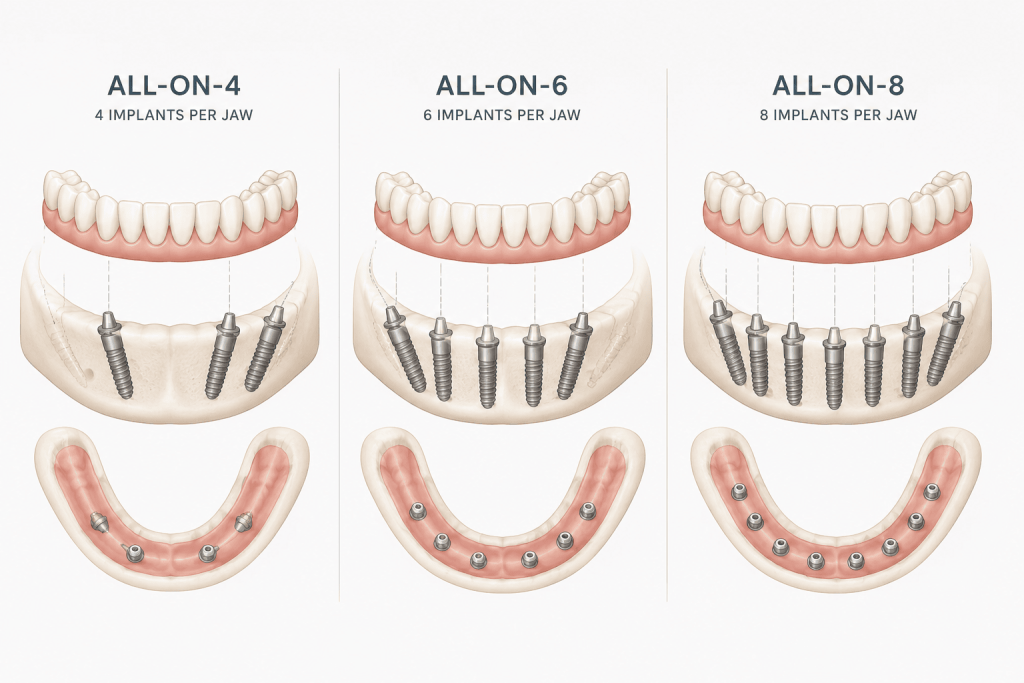
All-on-4, All-on-6, and All-on-8 describe how many titanium posts are placed into your jaw to hold a full arch of fixed teeth. The number you get directly affects how stable your smile feels, how chewing pressure is distributed across your jaw, and how the whole structure holds up if something goes wrong years down the line.
Think of it this way: a bridge supported by four pillars is functional, but a bridge supported by six or eight pillars handles unexpected loads far better. Your jaw works on the same principle.
According to the clinical research published in the Romanian Journal of Oral Rehabilitation (2024), the more implants you have in your jaw, the more evenly the pressure from eating and speaking is shared between them. That even distribution is what makes your new teeth feel like real ones, not prosthetics.
What All Three Options Have in Common
- All three use titanium implants placed directly into the jawbone.
- All three can support a full arch of fixed teeth on the same jaw.
- All three are graftless in most cases, meaning they work with the bone you already have.
- All three allow for immediate loading, which means temporary teeth can be attached within 24 to 48 hours of surgery.
Who Is Actually a Good Candidate for Each Option?
There is no universal answer here. The right number of implants depends on the quality and volume of your remaining jaw bone, which jaw is being treated (upper jaw bone is typically less dense), how many teeth you want, and whether your case has any complicating factors. Your specialist determines this after reviewing your 3D scan.
All-on-4 May Be Right for You If:
- You have adequate bone density in both the front and back of the jaw.
- You are comfortable with a 10 to 12 tooth prosthesis rather than a full 14-unit arch.
- Your case is straightforward with no significant complications.
- You understand that losing one implant would require restarting treatment.
All-on-6 May Be Right for You If:
- You want a full 14-unit arch for a more complete smile.
- You prefer the added security of two extra implants as a structural backup.
- Your bone situation in the back of the jaw requires angled posterior implants for stability.
- You are willing to invest in a slightly more comprehensive solution for greater long-term resilience.
All-on-8 May Be Right for You If:
- You are restoring the upper jaw, which has lower overall bone density and benefits most from additional anchor points.
- Your case involves significant bone resorption and requires maximum implant spread.
- You want the highest possible structural redundancy for a long-term restoration.
- Your prosthodontist recommends it based on your specific bone architecture after reviewing your scan.
All-on-4, All-on-6, and All-on-8 Side by Side
| Feature | All-on-4 | All-on-6 | All-on-8 |
| Number of implants per jaw | 4 | 6 | 8 |
| Max teeth supported | 10–12 units | 14 units | 14+ units |
| Load distribution | Moderate | Good | Excellent |
| Stability if one implant fails | Full restart required | Remaining 5 implants support the structure | Remaining 7 implants support the structure |
| Graftless approach possible | Yes | Yes (in most cases) | Yes (in most cases) |
| Immediate temporary teeth (24–48h) | Yes | Yes | Yes |
| Best suited for | Good bone density, standard cases | Full-arch restoration with higher stability needs | Upper jaw, complex cases, maximum support |
| Tilted / angled implants used | Yes (rear 2) | Yes (rear 2–4) | Yes (multiple) |
| Final prosthesis options | Zirconia or hybrid bridge | Zirconia or hybrid bridge | Zirconia or metal-ceramic bridge |
| Long-term prosthetic survival* | 99.65% at 18 years (based on cited research) | Strong with added redundancy | Strong with maximum redundancy |
The Science Behind Tilted Implants in All-on-X Procedures
Tilted, or angled, implants are placed at an angle instead of straight up and down into the bone. This is not a shortcut or a compromise. It is a deliberate surgical strategy that lets specialists reach denser, more stable bone deeper in the jaw, avoid important structures like nerve canals and sinus cavities, and achieve stronger initial grip without needing a bone graft.
The clinical research explains why this matters. In the upper jaw, bone density decreases toward the back because of the sinus cavities sitting above. By angling the rear implants to approach denser bone from a different direction, the surgeon gets a stronger hold than any straight implant placed in thin bone could ever achieve.
In the lower jaw, the same principle applies to protect the mandibular nerve. Angling the rear implants allows the surgeon to maximise the spread from front to back, which directly reduces the length of the unsupported bridge section. Shorter unsupported sections mean less flex in the prosthesis, which means a more natural and durable bite over the long term.
What Does the Research Say About Angled Implant Safety?
A one-year primate study by Celleti et al., cited in the 2024 paper, found that both straight and angled implants bond successfully to bone at equal rates, regardless of the angle of placement.
A later study by Krekmanov followed 22 patients with tilted lower jaw implants for at least 40 months and reported a 100% success rate. These are not small numbers for a surgical procedure.
What Causes Dental Implant Failure?
Implant failure is not common, but it does happen. The main reasons include insufficient primary stability at the time of placement, active gum infection, uncontrolled systemic conditions like diabetes, and smoking.
The clinical study cited above notes that any patient going through this procedure must have a minimum bone width of 4mm and a minimum bone height of 8mm at each implant site. Your 3D scan at consultation determines whether these thresholds are met.
The One Risk with All-on-4 That Clinics Rarely Mention Up Front
All-on-4 is the most widely used full mouth implant option worldwide, and it works well for many patients. But there is a structural limitation that the research is very clear about: with only four implants holding everything together, losing even one of them means the entire treatment has to restart from the beginning.
The 2024 peer-reviewed study is direct about this point. With All-on-4, a prosthesis can support only around 10 to 12 teeth units. If one implant fails, the whole structure is compromised and the case reverts to the starting point. That is not a sales pitch for a more expensive option. That is just how the physics of load distribution works at four points.
For many patients with good bone density and a straightforward case, All-on-4 is still an excellent choice. But it is something you deserve to know before making a decision that affects the next 15 to 20 years of your life.
What Happens After All-on-X Surgery? Understanding Immediate Loading
Immediate loading means that on the day of your surgery, or within 24 to 48 hours of it, a temporary set of fixed teeth is attached to your new implants. You do not go home with a gap. You leave with a functional smile that lets you speak normally and eat soft foods right away, while the implants bond to your bone over the following months.
This is one of the most significant practical advantages of all All-on-X treatments over older implant methods that required months of healing before any teeth were placed at all.
The 2024 clinical study confirms that immediate loading reduces the number of surgeries required, shortens the overall treatment timeline, and significantly improves patient satisfaction in terms of appearance, speaking ability, and psychological comfort.
The temporary restoration is not your final result. After the implants have fully fused with the bone, typically around six months after surgery, the temporary bridge is removed and a permanent custom zirconia or hybrid bridge is fitted. That final prosthesis is crafted to match your bite, your facial structure, and your aesthetic goals.
Is Immediate Loading Safe for All Patients?
Not for every patient, no. The research is clear that only implants with sufficient primary stability, meaning they are anchored firmly enough at the time of placement, qualify for immediate loading. This is assessed during surgery itself.
Patients with active gum infections, uncontrolled diabetes, or those who have had chemotherapy or radiotherapy within the past 12 months are typically excluded from this protocol until their health is properly managed.
The All-on-X Package in Dubai at Vibes Aesthetic Clinic from 24,997 AED
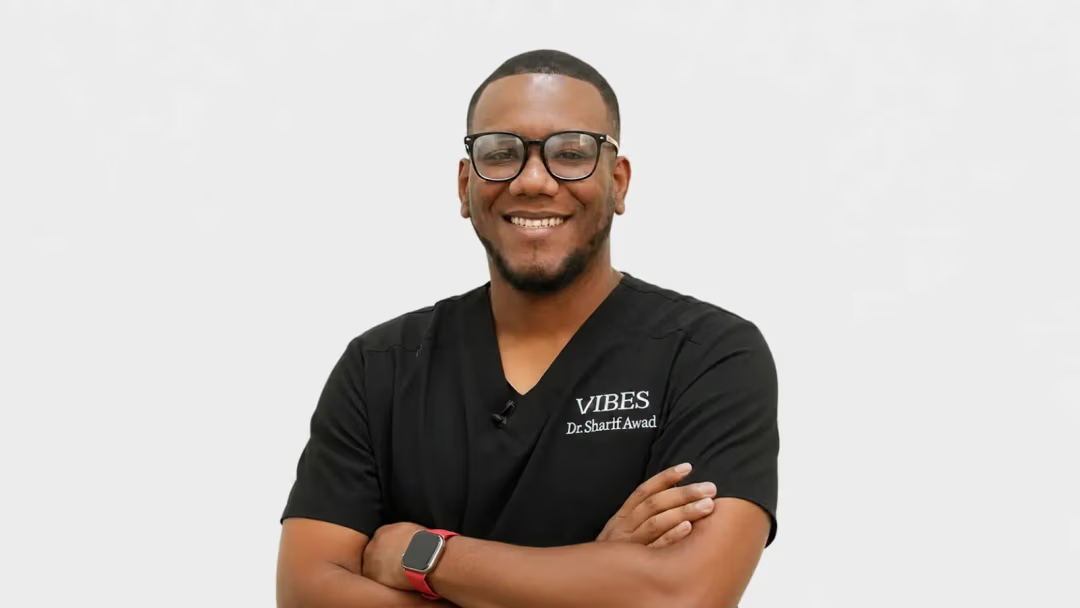
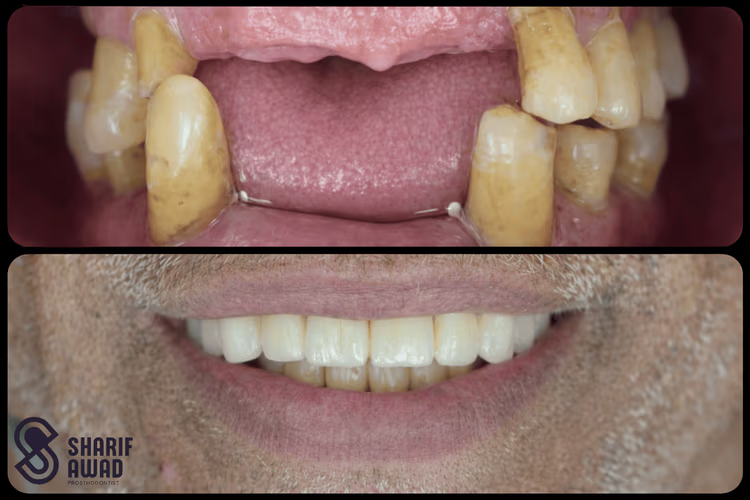
The All-on-X Full Mouth Implant Package at Vibes Aesthetic Clinic in Jumeirah starts from 24,997 AED and covers all the main stages of treatment under one price, performed by Dr. Sharif Awad, a DHA-licensed prosthodontist with over 10 years of specialist experience in full mouth rehabilitation.
Dr. Awad holds an MSc in Prosthodontics alongside international qualifications including MFD from Ireland, MFDS from Glasgow, and further post-doctoral training in implant dentistry from the University of the Western Cape. This level of multi-credential expertise is exactly what a treatment as involved as full mouth implants requires.
What the Package Covers
- Comprehensive consultation and full 3D digital scan of your jaw
- Personalised treatment planning tailored to your bone anatomy
- Placement of 4 to 6 titanium implants per jaw by a DHA-licensed specialist
- Temporary fixed prosthesis delivered within 24 to 48 hours
- Final zirconia or hybrid fixed bridge once healing is confirmed
- Local anaesthesia, sterilisation, and all essential consumables
- Full post-surgical care with structured follow-up visits
Vibes Aesthetic Clinic operates in Jumeirah with a spa-like environment and modern technology. Patients consistently highlight the calm, unhurried atmosphere as a significant factor in choosing to move forward with treatment.
Explore Our Exclusive Implant Packages
Common Myths About All-on-X Dental Implants
Misinformation about full mouth implants in Dubai is everywhere online. Before you dismiss this treatment or make a decision based on something you read in a forum, check these four common myths against what the clinical evidence actually says.
| Myth | Reality |
| “Bone grafting is always required before dental implants.” | All-on-X techniques were specifically developed to reduce or avoid the need for bone grafting in many patients. By placing implants into denser areas of bone at strategic angles, many full-arch cases can be treated without grafts. A 3D scan determines whether grafting is necessary for your specific anatomy. |
| “All-on-4 and All-on-6 are basically the same treatment with different pricing.” | The implant number directly affects stability, load distribution, and long-term structural support. All-on-4 typically supports 10–12 teeth, while All-on-6 can support a full 14-tooth arch with greater redundancy if one implant fails. |
| “Tilted implants are weaker than straight implants.” | Clinical evidence shows that angled implants integrate with bone just as successfully as straight implants. They are intentionally used to reach stronger bone regions and reduce unsupported bridge length, improving long-term biomechanics. |
| “Dental implants are extremely painful and recovery takes months.” | The procedure is usually performed under local anaesthesia, and most patients receive temporary fixed teeth within 24–48 hours through immediate loading protocols. Many patients return to normal daily activities much sooner than expected. |
Summary
If you have read this far, you already know the honest answer: there is no single best option for everyone. All-on-4 is a proven, effective solution for the right patient. All-on-6 raises the ceiling on both the completeness of your smile and the structural safety net around it. All-on-8 offers the highest level of support for the upper jaw or complex cases.
What they all share is the ability to give you fixed, natural-looking teeth that preserve your jaw bone, restore your confidence, and let you eat what you want without thinking twice.
The research is consistent on one thing above all else: correct diagnosis and treatment planning before surgery is what separates a life-changing result from a disappointing one. That starts with a 3D scan, a thorough bone assessment, and a specialist who is qualified to read both.
If you are ready to find out which option your jaw actually supports, Nova Voya makes that first step straightforward.
Our network includes verified, DHA-licensed clinics like Vibes Aesthetic Clinic in Jumeirah, where Dr. Sharif Awad and his team have built a reputation for precisely the kind of careful, patient-specific treatment planning this decision deserves.
You can request a free consultation through Nova Voya’s platform, speak with their team first to confirm suitability, and then move forward with full clarity on what your treatment will involve and cost.
Ready for a Full Smile Transformation in Dubai? 🦷
Nova Voya connects you directly with DHA-licensed implant specialists offering verified All-on-X packages in Dubai, so you get transparent pricing, a free consultation, and zero guesswork.
- ✔All-on-X package from 24,997 AED, fully itemised with no hidden fees
- ✔3D digital scan, surgery, temporary teeth, and final zirconia bridge included
- ✔Free consultation call with the Nova Voya team before any commitment
*Verified DHA-Licensed Clinics Only
What do you think matters most when choosing between All-on-4, All-on-6, and All-on-8: bone support, final smile outcome, or the precision of treatment planning before surgery?
FAQs
In most cases, yes, the upper jaw has lower bone density, so more implants spread the load more effectively and reduce the risk of overloading any single anchor point.
Many patients can, because the All-on-X technique uses angled implants to reach denser bone and avoid the need for grafting, but only your 3D scan confirms this for your specific jaw.
Longitudinal research shows a prosthetic survival rate of 99.65% at 18 years for All-on-4 configurations, with individual outcomes depending on oral hygiene and follow-up care.
With All-on-4, losing one implant means the entire treatment has to restart; with All-on-6 or All-on-8, the remaining implants can still support the prosthesis while the failed one is addressed.
If you qualify for immediate loading, based on implant stability assessed during surgery, a temporary fixed prosthesis can be placed within 24 to 48 hours of your procedure.
Yes, the package starting from 24,997 AED includes the final zirconia or hybrid fixed bridge, along with the 3D scan, surgery, temporary teeth, and all follow-up visits.
Through Nova Voya’s platform: submit a free consultation request, a brief call with the Nova Voya team confirms your suitability, and we coordinate directly with the clinic on your behalf.
Scientific Source: This article is based on peer-reviewed research by Marius Constantin Moraru, Catalin Mihai Buzduga, Irina Luciana Gurzu, et al., “The Advantage of the All-on-Six and All-on-Eight Technique Compared to the All-on-Four Technique,” published in Romanian Journal of Oral Rehabilitation, 2024, Vol. 16, No. 1, pp. 196–214. DOI: https://doi.org/10.6261/RJOR.2024.1.16.17