
Irritable Bowel Syndrome (IBS) affects about 1 in 10 people worldwide. And in a fast-paced city like Dubai, where stress is high and processed food is everywhere, getting the right care really matters.
This guide is for anyone in Dubai who wants to take IBS seriously: understand what’s causing it, know what treatments actually work, and find the right doctor and hospital to trust.
- Key Takeaways (TL;DR)
- Why Does It Matter So Much Which Doctor and Hospital You Choose for IBS?
- What Are the Foundational (First-Line) Treatments for IBS?
- How Does the Low-FODMAP Diet Work for IBS and Is It Right for You?
- Does a Gluten-Free Diet Help with IBS?
- What Medications Are Used to Treat IBS, Old and New?
- What Are the Newer Treatment Options That Could Change IBS Care?
- What Should You Look for in an IBS Specialist in Dubai?
- What Makes a Hospital Good for IBS Treatment in Dubai?
- What Questions Should You Ask to Evaluate an IBS Doctor, Treatment, or Hospital in Dubai?
- Who Are the Best IBS Gastroenterologists and Hospitals in Dubai?
- Dr. Yaser El-Gazzar: Senior Consultant Gastroenterologist & Hepatologist
- Dr. Yaser El-Gazzar
- Dr. Shabnam S: Specialist Gastroenterologist
- Dr. Shabnam S
- Dr. Lisa Sharkey: Consultant Gastroenterologist & Director of Education
- Dr. Lisa Sharkey
- Dr. Pooja Khanna: Consultant Gastroenterologist & Hepatologist
- Dr. Pooja Khanna
- Dr. Irfan Ali Shera: Consultant Gastroenterologist
- Dr. Irfan Ali Shera
- Myth vs. Reality: What People Get Wrong About IBS in Dubai
- Summary
- FAQs
Key Takeaways (TL;DR)
- IBS is a functional gut disorder, not a structural disease. It’s real, and it can seriously affect your life.
- Modern science links IBS to diet, stress, sleep, physical inactivity, and gut bacteria imbalances, all common in urban lifestyles.
- The most appropriate treatment depends on your individual symptoms and daily routine.
- Choosing the right doctor and hospital in Dubai is about finding someone who treats you, not just your symptoms.
Dr. Irfan Ali Shera
Consultant Gastroenterologist · 10+ Years Experience
Why Does It Matter So Much Which Doctor and Hospital You Choose for IBS?
IBS is not a simple condition you fix with one pill. It’s a complex syndrome with multiple triggers and the wrong approach can leave you frustrated for years.
Here’s why your choice of care matters:
- IBS symptoms vary widely. Some people mainly deal with constipation, others with diarrhea, and many with both. Treatment must match your specific type (IBS-C, IBS-D, or IBS-M).
- There is no single gold-standard cure. Research confirms that no medical intervention has yet been proven to change the long-term course of the disease. This means personalized, ongoing care is essential.
- Diet, psychology, and lifestyle are part of treatment. A doctor who only prescribes pills, without looking at these factors, is giving you an incomplete solution.
- The gut-brain connection is real. Mental stress signals your gut, and gut pain signals your brain back. A doctor who understands this loop will treat you more effectively.
IBS is like a car alarm that keeps going off. The wrong mechanic just disconnects the alarm. The right one figures out what’s actually triggering it.
What Are the Foundational (First-Line) Treatments for IBS?
First-line IBS treatment focuses on education, reassurance, and lifestyle change. Research confirms that patients who are fully informed and feel heard by their doctor often experience significant symptom relief, even before medication starts.
Lifestyle-based approaches include:
- Regular moderate exercise: Two clinical trials showed exercise reduces symptoms and improves quality of life in IBS patients. It also releases feel-good brain chemicals (serotonin and dopamine) that calm the gut.
- Dietary fiber (soluble type): Soluble fiber (like psyllium) has been shown effective for IBS, with a Number Needed to Treat (NNT) of 6. That means for every 6 people who use it consistently, 1 person sees clear relief. Note: Insoluble fiber (like wheat bran) can make symptoms worse.
- Eliminating alcohol and smoking: While clinical evidence is still limited, these are logical and safe steps. Heavy alcohol use has been found to double IBS risk in some populations.
- Improving sleep: Patients who sleep less than 8 hours a night, or work night shifts, are at measurably higher risk for IBS. Poor sleep activates the stress-gut feedback loop.
Best for
Anyone newly diagnosed, or with mild to moderate symptoms.
How Does the Low-FODMAP Diet Work for IBS and Is It Right for You?
The Low-FODMAP diet reduces certain carbohydrates that gut bacteria feed on and ferment, which can create extra gas in the digestive system. By lowering these foods, fermentation in the gut decreases, helping reduce bloating, stomach pain, and diarrhea.
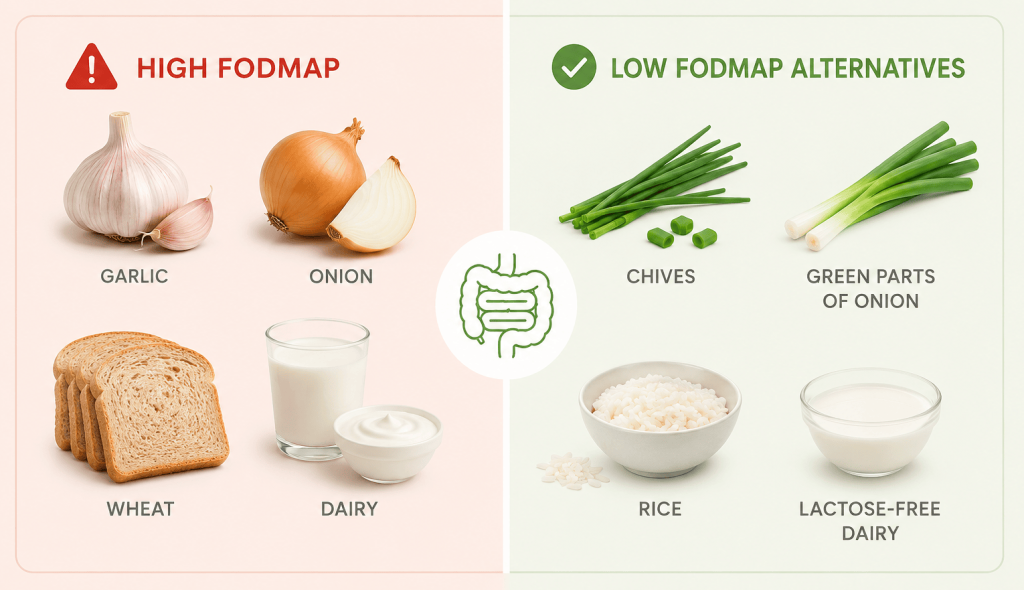
FODMAPs are found in:
- Dairy products (lactose)
- Wheat, garlic, onion (fructose and fructans)
- Processed foods with high-fructose corn syrup
- Many fruits: apples, pears, mangoes, watermelon
What the research says:
- At least 10 randomized clinical trials confirm that the Low-FODMAP diet reduces abdominal pain, bloating, and overall gut symptoms in 50–80% of IBS patients in the short term.
- One meta-analysis found significantly greater reduction in abdominal pain and bloating compared to control groups.
- In some trials, 86% of patients experienced relief from pain, bloating, and stool inconsistency.
Important caveats:
- The Low-FODMAP diet is not a forever diet. It has three phases: restriction, reintroduction, and personalization.
- It should be guided by a trained dietitian, doing it alone often leads to nutritional gaps.
- Long-term strict restriction may reduce beneficial gut bacteria.
Best for
IBS-D (diarrhea-dominant) and IBS-M (mixed) patients who haven’t responded to basic dietary changes. Also useful as a diagnostic tool.
Does a Gluten-Free Diet Help with IBS?
There is an overlap between IBS symptoms and non-celiac gluten sensitivity (NCGS). Some IBS patients feel better on a gluten-free diet but it may not be the gluten itself causing the problem.
Research suggests that the real culprit is often fructans (a type of FODMAP found in wheat) rather than gluten specifically. A gluten-free diet and a Low-FODMAP diet overlap significantly, which is why some patients feel better on both.
Downside:
Gluten-free diets can reduce beneficial gut bacteria and lower intake of calcium, iron, folate, and fiber.
Best for:
IBS-D patients who feel specifically worse after eating wheat-containing foods.
What Medications Are Used to Treat IBS, Old and New?
Pain and Spasms (IBS-All Types)
| Medication Type | Examples | Key Benefit |
| Antispasmodics | Otilonium, Hyoscine, Pinaverium | Relax gut muscle contractions |
| Peppermint Oil | Colpermin (new formulations) | Natural antispasmodic via calcium channel blocking |
IBS-C (Constipation-Dominant)
| Medication | Key Benefit |
| Linaclotide (FDA & EMA approved) | Reduces pain and improves stool frequency. |
| Lubiprostone (FDA approved) | Improves stool softness and frequency |
| Prucalopride (EMA approved) | Stimulates gut movement |
| Polyethylene glycol (PEG) | Increases stool frequency |
For IBS-D (Diarrhea-Dominant)
| Medication | Key Benefit |
| Rifaximin (FDA approved) | Reduces bloating and global symptoms. |
| Eluxadoline (approved EU & US) | Relieves pain AND diarrhea simultaneously |
| Loperamide | Reduces urgent diarrhea (short-term) |
| Ramosetron (Japan-approved) | Reduces diarrhea |
Pain + Psychological Comorbidity
| Medication | Key Benefit |
| Tricyclic antidepressants (TCAs) | Pain relief. Best for IBS-D. |
| SSRIs | Better for IBS-C (speeds gut transit). |
Best for: Moderate to severe IBS where diet and lifestyle alone aren’t enough.
What Non-Drug Approaches Work Best for IBS?
For patients with moderate to severe symptoms, especially those linked to stress and anxiety, psychological therapies are proven and powerful.
- Cognitive Behavioral Therapy (CBT): Multiple randomized controlled trials confirm CBT produces significant and lasting improvements in IBS symptoms and quality of life. Internet-based CBT is now also available.
- Gut-directed hypnotherapy: Reduces abdominal pain by calming brain regions that are overactive in IBS patients. Meta-analyses show strong short-term benefits.
- Mindfulness techniques: Help manage the catastrophizing (expecting the worst) that worsens IBS symptoms through the gut-brain axis.
Best for: Any IBS patient with significant anxiety, depression, burnout, or stress; which, according to research, is the majority.
What Are the Newer Treatment Options That Could Change IBS Care?
Research has identified several emerging treatments that go beyond classic approaches:
- Histamine H1 receptor blockers (e.g., Ebastine): Reduce gut hypersensitivity. Early trial showed improvement in overall IBS symptoms.
- Neurokinin-2 receptor antagonists (e.g., Ibodutant): A Phase II trial with 559 IBS-D patients showed meaningful improvement in pain, symptoms, and quality of life.
- Pregabalin (Voltage-gated calcium channel modulator): Reduces pain signals in the gut. Early trial results are promising, but safety data for IBS is still limited.
- Probiotics: Multiple meta-analyses confirm benefits for bloating and flatulence. However, results vary widely depending on species, strain, and dose; so not all probiotic products are equally effective.
What Should You Look for in an IBS Specialist in Dubai?
Choosing the right gastroenterologist is not just about their degree. Here’s what actually matters:
Positive signals (look for these):
- Experience with functional GI disorders: IBS is not a structural disease. Not all gastroenterologists specialize in functional disorders.
- A biopsychosocial approach: The best IBS doctors treat the whole person: gut, brain, diet, and stress. A doctor who only prescribes medication without exploring lifestyle is offering incomplete care.
- Willingness to explain: Research shows patients who are fully informed improve more. A doctor who rushes you through a 5-minute appointment is a red flag.
- Familiarity with FODMAP protocols: This is now a front-line tool in IBS management. A doctor who has never heard of it may not be current.
- Experience with the Rome IV criteria: This is the current international standard for diagnosing IBS. Ask your doctor if they use it.
Note: The Rome IV Criteria is a medical guideline doctors use to diagnose digestive problems like IBS (Irritable Bowel Syndrome). Instead of relying only on scans or blood tests, Rome IV focuses on a person’s symptoms, such as stomach pain, bloating, constipation, or diarrhea, and how often they happen. It helps doctors decide whether the gut problem is “functional,” meaning the digestive system looks normal but does not work properly. These guidelines make diagnosis more consistent and help patients get the right treatment faster.
Red flags (be cautious if):
- The doctor immediately recommends invasive procedures without ruling out simpler causes first.
- No mention of diet, sleep, or stress in the consultation.
- They dismiss your symptoms as “just anxiety” without a proper workup.
- They prescribe the same treatment regardless of your IBS subtype (C, D, or M).
What Makes a Hospital Good for IBS Treatment in Dubai?
Beyond the individual doctor, the facility itself matters.
A good IBS hospital should offer:
- Multidisciplinary care: Access to dietitians, psychologists (for CBT/hypnotherapy), and gastroenterologists in one place.
- Advanced endoscopy: To rule out other conditions (IBD, colon cancer, celiac disease) before confirming IBS.
- Diagnostic capabilities: Manometry studies, pH monitoring, capsule endoscopy for complex cases.
- Ongoing follow-up: IBS is chronic. A hospital that offers one consultation and sends you home is not the right fit.
What Questions Should You Ask to Evaluate an IBS Doctor, Treatment, or Hospital in Dubai?
Use these questions to assess your options before committing:
For the Doctor:
- “What IBS subtype do you think I have, and how does that affect my treatment?”
- “Do you use the Rome IV criteria for diagnosis?”
- “Are you familiar with the Low-FODMAP diet, and can you refer me to a dietitian?”
- “Which lifestyle adjustments should be combined with this medication?”
- “What do you do when first-line treatments are not effective?”
- “How do you monitor my progress over time?”
Questions About the Treatment Plan:
- “What are the side effects, and what is the Number Needed to Treat?”
- “Is this treatment covering my most troublesome symptom?”
- “What lifestyle changes should I make alongside this medication?”
About the Hospital or Clinic:
- “Do you have a dietitian who specializes in IBS and FODMAP protocols?”
- “Can I access psychological support (CBT or hypnotherapy) here?”
- “What diagnostic tools do you have available if my symptoms are atypical?”
- “How do you usually manage follow-up in long-term conditions like IBS?”
Who Are the Best IBS Gastroenterologists and Hospitals in Dubai?
Dr. Yaser El-Gazzar: Senior Consultant Gastroenterologist & Hepatologist
Dr. El-Gazzar has more than 30 years of clinical and academic experience in IBS and functional gastrointestinal disorders. UK-trained at Birmingham University Hospitals, he completed doctoral research at the Queen Elizabeth Hospital Liver Transplant Unit; one of Europe’s highest-volume liver centers.
Why he stands out for IBS:
- Holds multiple post-graduate qualifications including MRCP (Gastroenterology) and FESBGH (European Board).
- Special interest explicitly includes Irritable Bowel Syndrome and other Functional GI Disorders including chronic constipation and chronic diarrhea.
- Has performed over 30,000 endoscopic procedures, essential for ruling out conditions that mimic IBS.
- Former Chief of Endoscopy Service and Deputy Director of Bowel Cancer Screening in NHS East London.
- Has expertise in physiological studies including motility and pH studies; critical for complex IBS cases involving gut-brain axis dysfunction.
- Recognized by the Royal College of Physicians as a Trainer and Educator.
Best for:
Patients with complex or long-standing IBS, mixed symptoms, or those who need advanced diagnostics to rule out other GI conditions.

Dr. Yaser El-Gazzar
Senior Consultant Gastroenterologist & Hepatologist · 30+ Years Experience
Dr. Shabnam S: Specialist Gastroenterologist
With over nine years of clinical expertise, Dr. Shabnam provides comprehensive care for the full spectrum of digestive disorders, including IBS.
Why she stands out for IBS:
- Explicitly covers IBS as part of her clinical practice, alongside related conditions like GERD, gastritis, fatty liver, and IBD.
- Strong academic background, All India Rank 1 in the NEET 2017 Postgraduate Entrance Examination.
- Active research presenter at major international conferences including APDW Bangkok and ISGCON Varanasi.
- Proficient in diagnostic endoscopy, colonoscopy, and polyp removal, for reliable rule-out of structural conditions before IBS confirmation.
- Speaks English, Hindi, and Malayalam, an advantage for patients seeking care in their native language.
Best for:
Patients looking for a thorough, research-active specialist with strong diagnostic skills and an empathetic, communicative approach.

Dr. Shabnam S
Specialist Gastroenterologist · 9+ Years Experience
Dr. Lisa Sharkey: Consultant Gastroenterologist & Director of Education
Cambridge-trained (first-class honours), Dr. Sharkey joined Cambridge University Hospitals as a Consultant in 2015 after a research fellowship in Intestinal Failure and Liver Disease.
Why she stands out for IBS:
- Special interest includes functional GI disorders, the exact category IBS falls under.
- Deep expertise in nutrition support, small bowel disorders, and SIBO (Small Intestinal Bacterial Overgrowth), conditions that frequently overlap with and complicate IBS.
- Strong background in celiac disease and inflammatory bowel disease for differential diagnosis.
- Has spoken at global conferences and published in leading journals.
- Council member of the International Intestinal Rehabilitation and Transplant Association.
Best for:
Patients whose IBS overlaps with nutritional concerns, SIBO, celiac disease, or who need a specialist who bridges gastroenterology and nutrition.

Dr. Lisa Sharkey
Consultant Gastroenterologist · Cambridge-Trained
Dr. Pooja Khanna: Consultant Gastroenterologist & Hepatologist
UK board-certified with over 23 years of medical experience, Dr. Khanna trained at some of London’s most prestigious centers including St Thomas’ Hospital, Royal Free Hospital, and King’s College Hospital.
Why she stands out for IBS:
- Reflux and IBS are listed as explicit special interests, alongside hepatology and IBD.
- Her structured, evidence-based approach aligns with the research-supported, multifaceted management IBS requires.
- Completed specialist training at King’s College Hospital and Royal London Hospital.
- Active in hospital ethics committees, reflecting a patient-centered philosophy.
- Advanced endoscopic skills for comprehensive diagnostic workup.
Best for:
Patients who want a systematic, evidence-based approach and value long-term continuity of care.

Dr. Pooja Khanna
Consultant Gastroenterologist & Hepatologist · 23+ Years Experience
Dr. Irfan Ali Shera: Consultant Gastroenterologist
Dr. Irfan Ali Shera is a highly trained gastroenterologist with over 10 years of clinical experience, holding a DNB (Superspeciality) in Gastroenterology from the National Board of Examinations, India.
Why he stands out for IBS:
- Special interest in Functional & Motility Disorders, the clinical category that includes IBS.
- Over 2,500 diagnostic endoscopies and 1,500 colonoscopies performed for comprehensive diagnostic capability.
- Experience with High Resolution Esophageal Manometry and pH Impedance, advanced tools for assessing the gut-brain motility axis relevant to IBS.
- Member of both the American Society of Gastrointestinal Endoscopy and the Indian Society of Gastroenterology.
- Author of over 10 peer-reviewed publications in gastroenterology.
Best for:
Patients with IBS complicated by motility disorders, atypical symptoms, or those needing advanced diagnostic procedures.
Dr. Irfan Ali Shera
Consultant Gastroenterologist · 10+ Years Experience
Myth vs. Reality: What People Get Wrong About IBS in Dubai
| Myth | Reality |
| “IBS is just stress, it’s all in your head.” | IBS involves a real bidirectional connection between the brain and gut. Stress triggers genuine physical symptoms via the gut-brain axis. |
| “A colonoscopy will diagnose IBS.” | IBS is a diagnosis of exclusion. Colonoscopy helps rule OUT other conditions. IBS is diagnosed clinically using Rome IV criteria based on symptom patterns. |
| “If I just avoid gluten, I’ll be fine.” | For many patients, the real issue is FODMAPs (fermentable carbs), not gluten specifically. A Low-FODMAP protocol is more targeted and evidence-based. |
| “Probiotics always help IBS.” | Some probiotics help some people. But results depend entirely on the specific strain, dose, and individual microbiome. Not all products work equally. |
| “IBS will eventually resolve on its own.” | No treatment has been proven to alter the long-term natural history of IBS. Without addressing root causes and triggers, symptoms typically persist or fluctuate. |
| “You need strong medication to treat IBS.” | First-line treatment is often non-pharmacological: reassurance, diet changes, exercise, and stress management. Medication is added when these don’t provide enough relief. |
| “IBS only affects anxious people.” | While anxiety and depression are significant risk factors, IBS can affect anyone. Physical factors like dietary habits, microbiome composition, and sleep also play a major role. |
Summary
IBS is one of the most common and most mismanaged conditions in modern healthcare. The science is clear on what works and Dubai has world-class specialists who can deliver it.
Here’s what you now know that most people don’t:
- IBS treatment must match your specific subtype (C, D, or M).
- Diet, sleep, exercise, and stress are not “optional extras”, they’re core treatment components.
- The best doctors treat the whole person, not just the symptoms.
- Asking the right questions before your appointment can save you months of misdirected treatment.
Nova Voya connects patients in Dubai with the right specialists for complex conditions like IBS. Whether you’re looking for a second opinion, need help navigating your options, or want to be matched with the right gastroenterologist for your symptoms, Nova Voya can help you.
Seeking World-Class Medical Care in Dubai? 🏥
Nova Voya helps international patients seamlessly navigate advanced healthcare in Dubai. We connect you with top-tier medical specialists and accredited hospitals tailored precisely to your unique healthcare needs, ensuring a smooth, safe, and stress-free medical journey.
- ✔ Personalized matching with leading medical experts and premier facilities
- ✔ Full support with medical coordination, second opinions, and logistics
- ✔ Independent, honest guidance focused entirely on your health goals
*Medical tourism guidance, not clinical advice
What has been the hardest part of managing your IBS in Dubai?
FAQs
The Low-FODMAP diet is currently the most evidence-supported dietary approach for IBS, with 50–80% of patients reporting symptom improvement in clinical trials.
Your gastroenterologist will classify your IBS subtype based on your predominant bowel habits (constipation, diarrhea, or a mix of both) using the Rome IV diagnostic criteria.
No treatment has been proven to permanently cure IBS. However, the right combination of diet, lifestyle changes, medication, and psychological support can achieve meaningful and sustained symptom control.
Stress doesn’t directly cause IBS, but it activates the gut-brain axis in a way that triggers or worsens symptoms. Chronic stress is a well-documented risk factor for IBS development and flare-ups.
Hospitals like King’s College Hospital Dubai and Aster Hospital in Dubai offer experienced gastroenterologists with explicit expertise in IBS and functional GI disorders, along with advanced diagnostic capabilities.
Not always, but endoscopy is important to rule out other conditions like IBD, celiac disease, or colorectal cancer before confirming an IBS diagnosis.
Some probiotics show benefits for bloating and flatulence in IBS patients, but results vary by strain and individual. Consult your gastroenterologist before starting a probiotic supplement.
Yes, several gastroenterologists and dietitians in Dubai are trained in FODMAP protocols and can guide you through the three-phase process correctly.
This varies by individual and approach. Dietary interventions typically show results within 4–8 weeks. Medication and psychological therapies may take 3–6 months for full benefit.
Scientific Sources: This article is informed by two peer-reviewed studies:
Makenna B. Lenover and Mary K. Shenk, “Evolutionary Medicine Approaches to Chronic Disease: The Case of Irritable Bowel Syndrome,” published in Evolutionary Anthropology, 2024, Vol. 33, Article e22010. DOI: https://doi.org/10.1002/evan.22010
Paolo Usai-Satta, Massimo Bellini, Mariantonia Lai, Francesco Oppia, and Francesco Cabrasa, “Therapeutic Approach for Irritable Bowel Syndrome: Old and New Strategies,” published in Current Clinical Pharmacology, 2018, Vol. 13, pp. 1–9. DOI: https://doi.org/10.2174/1574884713666180807143606