
Imagine looking in the mirror every morning and feeling like your eyes are making you look older or more tired than you actually are. Maybe your upper eyelids are drooping and covering part of your eye. Maybe the bags under your eyes make people ask if you slept badly, even when you had a full night of rest.
So you start researching blepharoplasty in Dubai. And almost immediately, a fear kicks in: What if I end up looking overdone? What if my eyes look stretched or unnatural?
This fear is one of the most common reasons people delay or avoid eyelid surgery, even when they genuinely need it.
This guide will give you clear, science-backed answers. You will learn who actually needs this surgery, what the different techniques involve, what to expect before and after, and how to choose a surgeon in Dubai you can truly trust.
- Key Takeaways: (TL;DR)
- What Exactly Is Blepharoplasty And Why Are So Many People Getting It?
- Are You Actually a Good Candidate for Blepharoplasty?
- Upper vs. Lower vs. Asian Blepharoplasty: Which One Is Right for You?
- What Should You Realistically Expect Before and After Surgery?
- Biggest Mistakes People Make When Choosing a Blepharoplasty Clinic or Surgeon
- Which Surgeons and Clinics in Dubai Are Worth Considering?
- Blepharoplasty Myths vs. Reality
- Summary
- FAQs
Key Takeaways: (TL;DR)
- Blepharoplasty (eye-lid surgery) is one of the top 5 most performed cosmetic surgeries in the world and Dubai is a growing hub for it.
- Not everyone is a good candidate. Your health history, skin type, and expectations all matter before you book anything.
- There are three main types: upper, lower, and Asian blepharoplasty, each with different goals, recovery times, and results.
- The biggest risk is not the surgery itself, it is choosing the wrong surgeon or having unrealistic expectations.
- Non-surgical options like fillers and laser treatments are real alternatives for mild cases.
- Nova Voya connects you with trusted, verified plastic surgeons in Dubai so you can compare and decide with confidence.

Dr. Manoj Kumar
Plastic & Reconstructive Surgeon · 25+ Years Experience
What Exactly Is Blepharoplasty And Why Are So Many People Getting It?
Blepharoplasty (say it: bleh-FAIR-oh-plas-tee) is a surgical procedure that repairs or reshapes the upper and/or lower eyelids. Surgeons use it to remove extra skin, reduce puffiness from fat deposits, and fix eyelids that have become loose or droopy over time. It takes around 45-60 minutes for basic procedures and is one of the five most commonly performed cosmetic surgeries in the world.
According to research published in the World Journal of Clinical Cases (2023), blepharoplasty has consistently ranked among the top five most frequently performed cosmetic procedures worldwide over the past decade, alongside facelifts and nose reshaping surgery.
The periocular region (the area around your eyes) is usually the first part of the face to show signs of aging. This is why so many people (both men and women) seek help for this area.
The procedure can be done for two reasons:
- Cosmetic: To improve how your eyes look.
- Functional: To fix drooping eyelids that block your vision.
Sometimes both goals are achieved in the same operation.
Are You Actually a Good Candidate for Blepharoplasty?
You may be a good candidate for blepharoplasty if you have excess (extra) eyelid skin, fatty puffiness around the eyes, loose or drooping lids, or a blocked field of vision caused by sagging upper eyelids. Good candidates are also in good general health, do not smoke heavily, and have realistic expectations about results.
But not everyone qualifies. Based on the research by Oestreicher and Mehta (2012), surgeons screen patients carefully before agreeing to operate.
Who is likely a good candidate?
- People with visibly drooping upper eyelids (called dermatochalasis, pronounced der-mah-toh-kah-LAY-sis, meaning too much loose eyelid skin)
- People with eye bags caused by fat that has shifted forward under the skin
- People with loose, lax lower eyelids
- People in good general health, without uncontrolled diabetes, thyroid disease, or serious heart conditions
- People with realistic goals, not perfection, but genuine improvement
Who is NOT a good candidate?
According to the same research, surgeons should avoid operating on:
- Patients who want absolutely zero visible eyelid fold
- Patients who already had surgery and want even more correction on top of an over-corrected result
- Patients who plan to go back to a demanding job the very next day or travel within the first week
- Patients who treat cosmetic surgery as something they can simply buy, without understanding it is a medical procedure with real risks
Important note from the research: Before any surgery, patients should stop taking aspirin, blood thinners (anticoagulants), vitamin E supplements, and certain herbal medicines up to three weeks before the procedure, as these increase the risk of bleeding.
Dr. Dragana Spica
Specialist Plastic & Reconstructive Surgeon · 19 Years Experience
Upper vs. Lower vs. Asian Blepharoplasty: Which One Is Right for You?
There are three main types of blepharoplasty. Each targets a different area and solves a different problem. Choosing the right one depends on your specific concern, your anatomy, and your recovery tolerance.
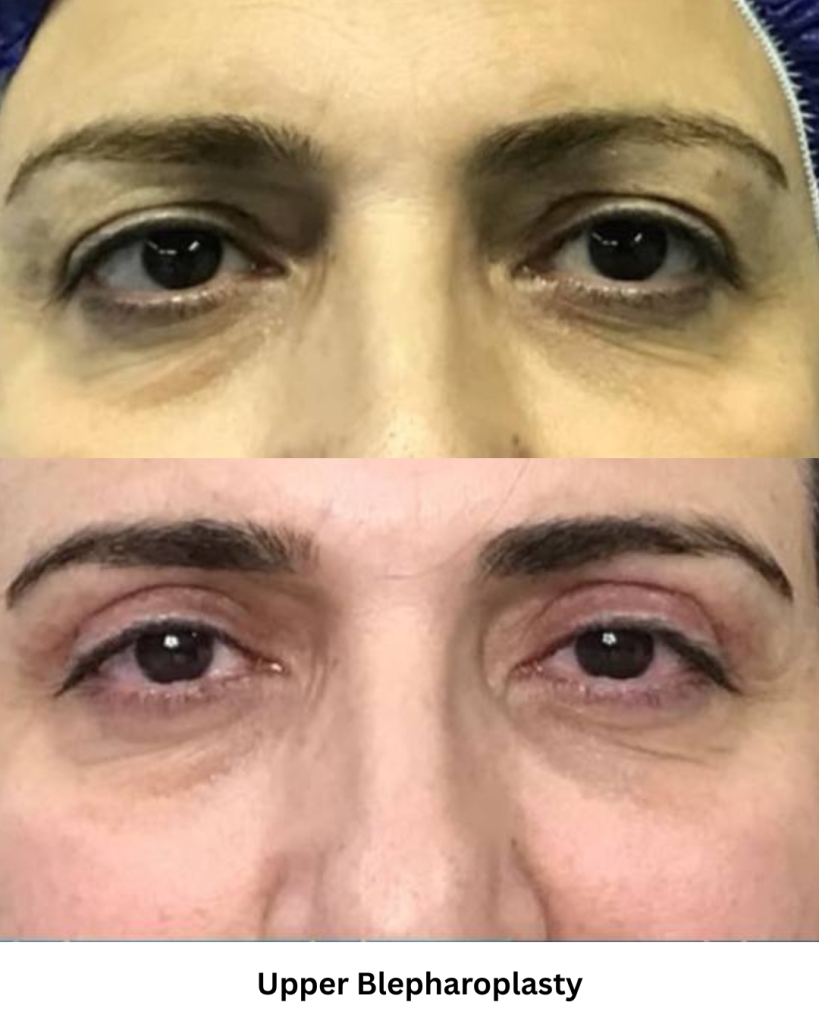
Upper Blepharoplasty: Is It Right for Your Drooping Upper Eyelids?
Upper blepharoplasty targets excess skin and fat on the upper eyelid. Research confirms it is highly effective for mild to moderate cases of dermatochalasis (loose upper eyelid skin).
| Feature | Details |
| Main problem it fixes | Droopy or heavy upper eyelids, blocked vision, tired appearance |
| Technique | Surgeon removes or repositions excess skin and fat through an incision in the natural eyelid crease |
| Scarring | Scar is hidden inside the natural fold of the upper lid |
| Downtime (recovery time) | Approximately 7-10 days before returning to most activities |
| How natural does it look? | Very natural when done conservatively |
| Best for | Men and women with excess upper lid skin, early signs of aging around the eyes |
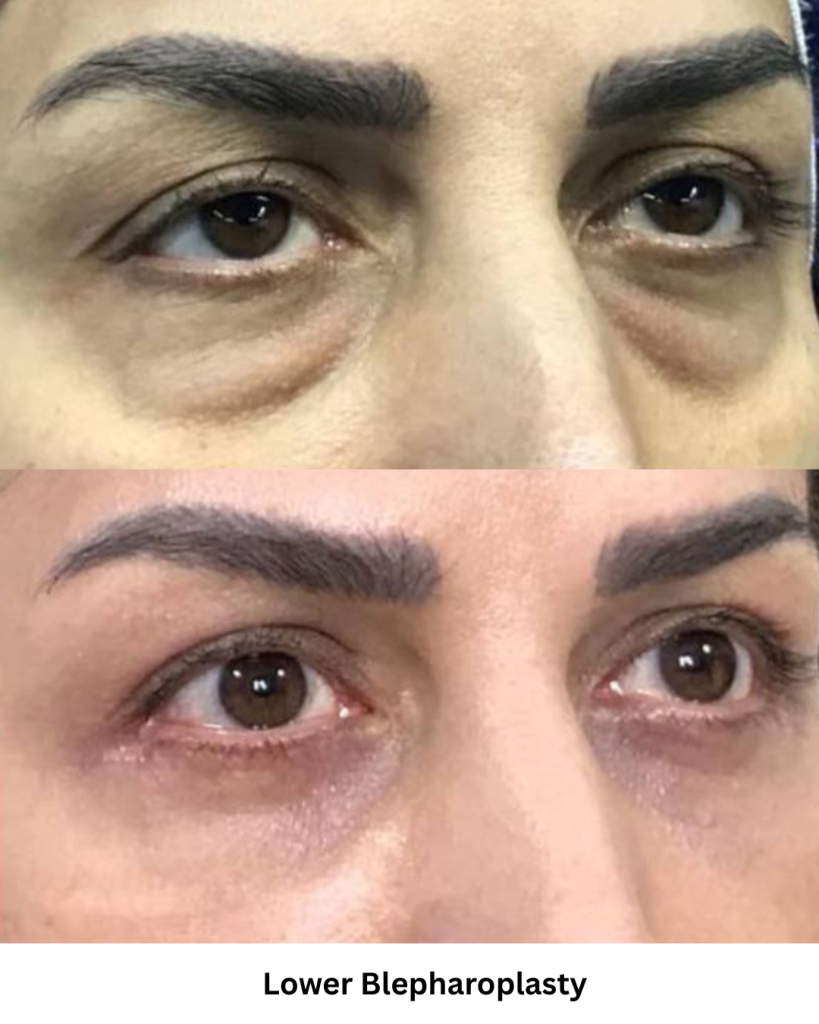
Lower Blepharoplasty: Can It Really Remove Your Eye Bags?
Lower blepharoplasty focuses on the under-eye area. It addresses puffiness (from fat), fine lines (small wrinkles), and excess skin below the eye.
| Feature | Details |
| Main problem it fixes | Eye bags, under-eye puffiness, lower lid wrinkles |
| Technique | Surgeon accesses fat either through a hidden incision inside the eyelid (transconjunctival — inside the lower lid) or through an external cut just below the lashes |
| Scarring | Transconjunctival approach leaves no visible scar; external approach scar is hidden below lashes |
| Downtime | Approximately 10-14 days |
| How natural does it look? | Excellent results with transconjunctival approach, especially in younger patients |
| Best for | People with significant under-eye bags or excess lower lid skin |
According to the research by Oestreicher and Mehta (2012), the transconjunctival (inside the eyelid) lower lid approach is preferred because it reduces the risk of complications like eyelid retraction (when the lower lid pulls downward).
Asian Blepharoplasty: Does It Change Your Ethnicity or Just Enhance Your Eyes?
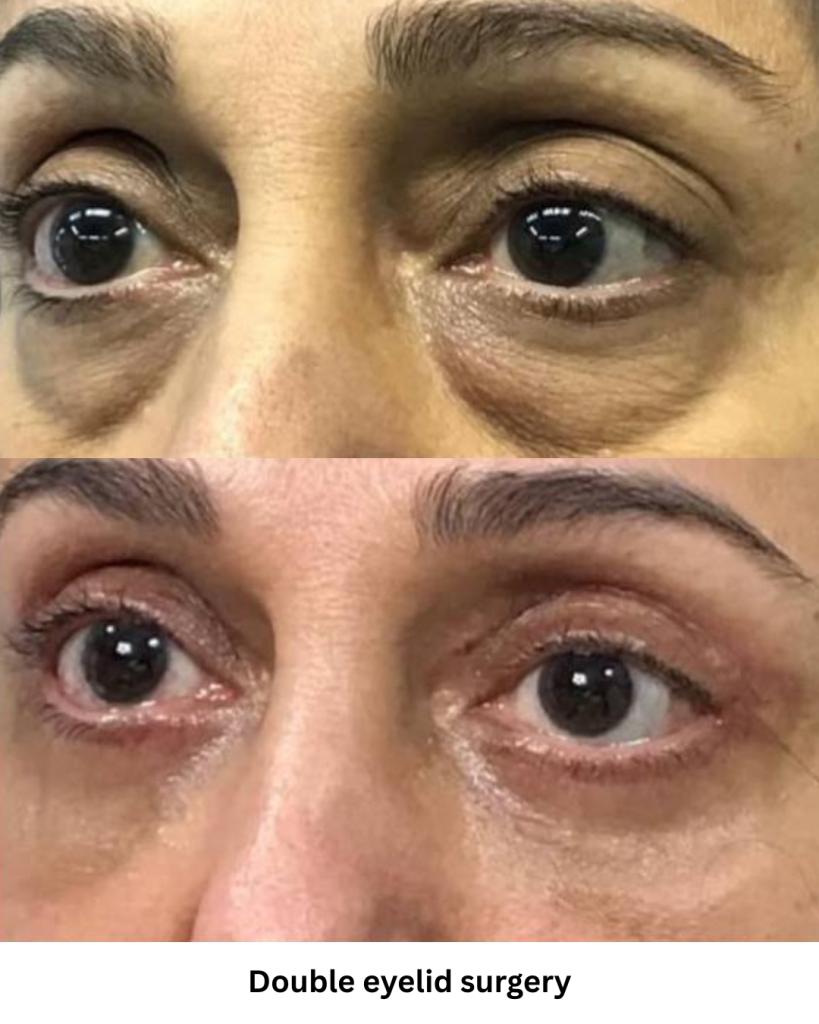
Asian blepharoplasty (also called double eyelid surgery) is a specific procedure for patients of Asian background who do not have a visible upper eyelid crease, or whose crease is very low.
| Feature | Details |
| Main problem it fixes | Absent or minimal upper eyelid crease, heavy-looking upper lids |
| Technique | Creates or defines an upper eyelid fold by attaching skin to underlying structures |
| Scarring | Minimal, hidden in the new crease |
| Downtime | Approximately 7-10 days |
| How natural does it look? | Natural when crease is kept low (3-5 mm in younger patients); unnatural if set too high |
| Best for | Asian patients who want a defined eyelid crease without a “westernized” appearance |
The research is very clear on one important point: the crease must not be placed too high. Placing it too high creates an overly dramatic, unnatural look. The most common complication in Asian blepharoplasty is asymmetry (one eye looking different from the other) and meticulous surgical planning is the only way to minimize this.
What Should You Realistically Expect Before and After Surgery?
Blepharoplasty can significantly improve the appearance of your eyes and, in functional cases, even improve your vision. But it is not a perfect, permanent fix. Results depend on your age, skin quality, chosen technique, and surgeon skill. Swelling, bruising, and mild discomfort are normal after the procedure. Most patients see their final results after 3-6 months.
What happens before surgery?
According to the research by Oestreicher and Mehta (2012), a thorough pre-surgery check-up must include:
- A full eye examination (checking vision, lid position, eye dryness, and more)
- Discussion of your specific concerns and desired outcome
- Review of your medical history (heart conditions, thyroid disease, blood pressure, diabetes)
- Review of all medications and supplements you currently take
- Photographs to document your starting point
What happens right after surgery?
Expect:
- Bruising and swelling; this is normal for every single patient, not a complication
- Mild discomfort and blurred vision from the eye ointment your surgeon applies
- Ice water compresses (cold wet cloths) for the first three days to reduce swelling
- Head elevation (keeping your head higher than your heart) to reduce fluid buildup
- Do not drive for the first week due to blurriness from the ointment
What about long-term results?
Surgery is not permanent in the sense that aging continues. However, results typically last many years. Non-surgical alternatives like laser treatments or hyaluronic acid (HA) fillers offer shorter-lasting results, usually 6 to 12 months for fillers.
Biggest Mistakes People Make When Choosing a Blepharoplasty Clinic or Surgeon
The biggest mistakes include choosing a surgeon based on price alone, not checking whether the surgeon specializes in eyelid or periocular surgery, skipping the consultation, and not disclosing your full medical history. Choosing the wrong surgeon is far more dangerous than the surgery itself.
Mistake 1: Choosing based on the lowest price
Eyelid surgery is complex. The anatomy around the eyes involves delicate structures like the levator muscle (the muscle that lifts your eyelid), the orbital septum (a thin membrane separating the eyelid from the eye socket), and the lacrimal system (tear drainage). A surgeon who does not deeply understand these structures can cause serious complications.
Mistake 2: Not asking about the surgeon’s specific experience with eyelid surgery
Plastic surgery is a broad field. Ask specifically: How many blepharoplasty procedures has this surgeon performed? Do they have experience with your specific type (upper, lower, or Asian)?
Mistake 3: Hiding your medical history
As described in the research, conditions like thyroid disease, high blood pressure, diabetes, and a history of dry eyes can significantly affect how surgery goes and how you heal. Be completely honest with your surgeon.
Mistake 4: Having unrealistic expectations
If you want to look like a completely different person or expect zero signs of aging after surgery, you are not ready for this procedure. Good surgeons in Dubai will tell you this honestly during your consultation.
Which Surgeons and Clinics in Dubai Are Worth Considering?
Based on verified professional profiles, here are two highly experienced surgeons available in Dubai:
Dr. Manoj Kumar: Canadian Hospital Dubai
Dr. Manoj Kumar is a plastic and reconstructive surgeon with more than 25 years of experience. He trained in India (MBBS, MS in General Surgery, MCh in Plastic Surgery), then in the UK (FRCS, Fellow of the Royal College of Surgeons, and a Fellowship in Cosmetic Surgery from London).
Dr. Kumar also spent nearly a decade working in the UK’s National Health Service (NHS) before serving as Head of the Department of Plastic Surgery at Max Super Specialty Hospital in New Delhi for over 10 years.
Manoj Kumar has performed more than 10,000 cosmetic surgeries and moved to Dubai in 2019.
His dual UK and Indian board certifications, combined with his long tenure as a department head, reflect both technical depth and leadership-level clinical experience.
Dr. Manoj Kumar
Plastic & Reconstructive Surgeon · 25+ Years Experience
Dr. Dragana Spica: Kings College Hospital Dubai
Dr. Dragana Spica is a specialist plastic and reconstructive surgeon with 19 years of progressive experience. She is a Serbian board-certified surgeon who graduated from the University of Belgrade in 2005, completed a Master’s degree in Surgical Anatomy, and finished her postgraduate specialization in Aesthetic and Reconstructive Surgery in 2014.
Her specific interests include upper blepharoplasty, lower blepharoplasty, face and neck lift, and various non-surgical procedures. She is affiliated with the Serbian Society of Aesthetic Plastic Surgeons (SRBSAPS) and the Emirates Plastic Surgery Society (EPSS). She practices at the Aesthetics Clinic, Dubai Marina Clinic, and Dubai Hills Hospital.
Her strong academic background in surgical anatomy, combined with membership in both international and UAE-specific plastic surgery societies, shows a commitment to both precision and local professional standards.
Dr. Dragana Spica
Specialist Plastic & Reconstructive Surgeon · 19 Years Experience
Blepharoplasty Myths vs. Reality
| Common Myth | The Reality |
| Blepharoplasty will make your eyes look fake or overdone | When done conservatively by an experienced surgeon, results look natural. Over-correction happens when too much skin or fat is removed, a surgeon’s planning is key. |
| The surgery is permanent and you will never need anything again | Results last years, but aging continues. A touch-up may be needed in the future. |
| Laser blepharoplasty is always better than traditional surgery | Research shows that many patients incorrectly believe laser surgery is simpler, less painful, and faster to recover from. In reality, each technique has its own pros, cons, and best-use cases. |
| Non-surgical options like fillers give the same results as surgery | Fillers and laser treatments are great for mild cases or early aging, but cannot replace surgery for moderate to severe cases with significant excess skin or tissue. |
| Blepharoplasty is only for older people | People of various ages seek this procedure; for cosmetic reasons, functional reasons, or cultural preferences such as Asian double eyelid surgery. |
| Bruising means something went wrong | Bruising after blepharoplasty is expected and normal for every patient. It is a side effect, not a complication. |
| You can return to work the next day | Most patients need 7-14 days before returning to non-strenuous work. Returning too soon increases risks of complications. |
Summary
Blepharoplasty in Dubai can be a life-changing procedure when done for the right reason, with the right surgeon, using the right technique. The science is clear: patient selection, honest communication, and surgeon experience are what separate a great outcome from a disappointing one.
If you have been researching eyelid surgery and feel overwhelmed by the options, you are not the first person to feel that way. The encouraging part is that you don’t have to navigate the process alone.
Nova Voya is a medical guidance platform that helps international and local patients connect with verified, experienced surgeons and clinics in Dubai and across the UAE. Instead of spending hours scrolling through clinic websites or relying on sponsored ads, Nova Voya lets you:
- Compare qualified blepharoplasty surgeons side by side
- Access real patient reviews and verified credentials
- Book a free initial consultation without any pressure
- Receive personalized guidance based on your specific concern
The right surgeon will listen to your fears, explain your options honestly, and tell you, when necessary, that you may not need surgery at all.
Seeking World-Class Medical Care in Dubai? 🏥
Nova Voya helps international patients seamlessly navigate advanced healthcare in Dubai. We connect you with top-tier medical specialists and accredited hospitals tailored precisely to your unique healthcare needs, ensuring a smooth, safe, and stress-free medical journey.
- ✔ Personalized matching with leading medical experts and premier facilities
- ✔ Full support with medical coordination, second opinions, and logistics
- ✔ Independent, honest guidance focused entirely on your health goals
*Medical tourism guidance, not clinical advice
What is the one thing about your eyes you would most like to improve and have you had a professional consultation yet?
FAQs
When performed by a board-certified specialist with proper preoperative screening and in an accredited facility, blepharoplasty is considered a safe procedure. Serious complications such as vision loss are rare, estimated at 1 in 2,000 to 1 in 25,000 cases according to published research.
Most patients are able to resume light daily activities within 7–10 days. Full recovery, including resolution of all swelling, typically takes 3-6 months.
Yes. Many patients combine blepharoplasty with a brow lift, ptosis repair (fixing a drooping eyelid), or lower eyelid tightening in the same operation. Your surgeon will provide guidance tailored to your individual case.
Surgical blepharoplasty physically removes or repositions skin and fat for long-lasting results. Non-surgical options, such as hyaluronic acid fillers (gel injected under the skin), laser resurfacing, or plasma treatments, are less invasive and suit mild cases, but results last months rather than years.
Upper blepharoplasty is for drooping, heavy upper eyelids. Lower blepharoplasty is for eye bags and wrinkles beneath the eye. Some patients need both. A surgeon will assess your eyelid anatomy and recommend the appropriate approach.
Insurance typically covers blepharoplasty only when it is performed for functional reasons, such as when drooping eyelids block your vision. Cosmetic procedures are generally not covered. Check with your insurer before proceeding.
Yes. Dubai has a large and diverse population, and Asian blepharoplasty is performed regularly by experienced plastic surgeons. The key is finding a surgeon familiar with Asian eyelid anatomy to ensure a natural, proportionate result.
Surgical blepharoplasty results typically last many years, though aging continues. Non-surgical treatments like fillers generally last 6-12 months before a repeat session is needed.
Look for a board-certified plastic or ophthalmic plastic surgeon with specific experience in eyelid procedures. Check their credentials, ask how many blepharoplasties they perform per year, and always attend a consultation before committing. Nova Voya can help you compare verified surgeons in Dubai.
Scientific Sources: This article is informed by two peer-reviewed studies:
Miotti G, Zeppieri M, Pederzani G, Salati C, and Parodi PC, “Modern Blepharoplasty: From Bench to Bedside,” published in World Journal of Clinical Cases, 2023, Vol. 11, Issue 8, pp. 1719-1729. DOI: https://dx.doi.org/10.12998/wjcc.v11.i8.1719
Oestreicher J and Mehta S, “Complications of Blepharoplasty: Prevention and Management,” published in Plastic Surgery International, 2012, Article ID 252368. DOI: https://doi.org/10.1155/2012/252368