

Curly hair breakage is super common. And the damage usually starts way before you ever notice it. Here’s what a real scientific study found and what it actually means for your hair routine.
- Key Takeaways: (TL;DR)
- The Breakage Problem Is Bigger Than You Think
- What Actually Makes Curly Hair More Vulnerable?
- The 4-Step Story of How Curly Hair Breaks
- The Sneaky Truth: Damage Hides Where You Can't See It
- How to Read Your Breakage
- What Your Hair Actually Needs
- Myths vs. Reality: What Research Actually Says About Curly Hair Breakage
- Summary
- FAQs
Key Takeaways: (TL;DR)
- 96% of African-American women in one survey deal with hair breakage
- 23% say it’s their #1 hair concern
- Curly hair isn’t chemically weaker, it’s structurally different
- Damage builds up invisibly inside the strand before anything snaps
- Breaks don’t always happen at curls or kinks — they happen anywhere
- The damage follows a 4-step process that starts deep inside the hair
- A consistent, friction-reducing routine is the research-backed fix

Innovative Non-Surgical Hair Restoration
The Breakage Problem Is Bigger Than You Think
A survey of women of African descent found that 96% experience hair breakage. That’s huge. But here’s the surprising part:
Curly hair isn’t made of weaker stuff. The chemistry is basically the same as other hair types.
So what’s going on?
Two things are working against each other:
The daily stress of grooming it
The unique shape and structure of curly hair
What Actually Makes Curly Hair More Vulnerable?
Curly hair is more vulnerable by structure. The combination of a complex internal architecture and the physical forces from daily grooming creates conditions where damage accumulates faster and more unpredictably than in straighter fibre types.
Your Hair Is a Layered Engineering Marvel
Your Hair Is Like a Layered Rope
Think of your hair like a rope made of smaller ropes, each one twisted inside the other. Here’s how it’s built, from the inside out:
- The core: Tiny protein coils (think of them like mini springs) bundle together to form the inner strength of the strand
- The middle: Those bundles pack together like bricks and mortar to form the main body of the hair
- The outer shell (cuticle): 5–10 flat layers stacked like roof tiles, this is your hair’s protective armor
Each layer has a job. Together, they share the pressure when your hair gets pulled or bent.
The Role of Twists and Kinks in Curly Hair
Curly hair has natural twists, kinks, and tight bends along the strand.
These spots act like weak points in a metal chain; when force is applied, stress tends to pile up there instead of spreading out evenly.
But here’s the twist (pun intended):
Most breaks don’t even happen at these kinks.
In the study, researchers looked at 20 broken hair samples. Only 4 of them broke at a visible twist. The rest broke in smooth, normal-looking sections.
Something invisible was happening inside the hair.
Grooming Forces: The Slow Build-Up
Every time you comb, detangle, or style your hair, you’re adding a tiny bit of mechanical stress (stretching, bending, twisting) to each strand.
Your hair carries all of that, silently, even when it looks totally fine.
This is why researchers say: choose tools and routines that reduce friction and force. Every session adds to the damage score.
The 4-Step Story of How Curly Hair Breaks
Scientists used super-powered microscopes (including X-ray scanning technology similar to what’s used in hospitals) to watch hair break in slow motion. Here’s exactly what they found:
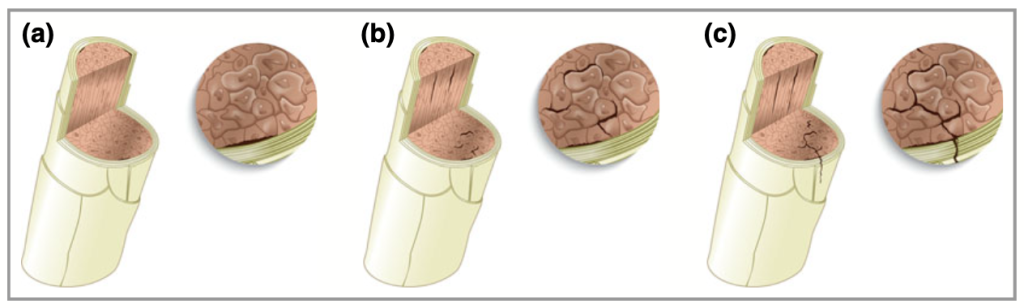
Step 1: The Outer Shell Starts to Slide
Remember those roof tiles (the cuticle)?
Under stress, those tiles start to lift and shift. The glue holding them together is naturally pretty weak.
The sneaky part? When you release the stress, they snap back. Your hair looks fine. But something already happened.
Step 2: The Shell Disconnects from the Core
With more stress, the outer shell fully detaches from the inner body of the hair.
Now the core has to carry ALL the load by itself, like a building that lost its outer walls. It gets stiffer and more fragile.
Step 3: Tiny Cracks Form Inside
This is where it gets wild.
Invisible cracks start forming deep inside the hair shaft, right at the junction between the outer shell and the core. These are like micro-fractures in a windshield, small at first, but multiplying fast.
The hair can’t absorb stress as well anymore. Its cross-section starts to get narrower at the future break point.
You still can’t see any of this from the outside.
Step 4: The Final, Unpredictable Break
Once the cracks reach a critical level, they push outward and merge and the strand breaks.
The wild part? It can break anywhere. There’s no visual warning. No obvious weak spot on the surface.
This is why breakage feels so random. It’s not random, it’s just invisible.
The Sneaky Truth: Damage Hides Where You Can’t See It
Here’s the thing most people don’t realize:
A hair strand can look shiny, smooth, and healthy and still be about to break.
Why? Because:
- The cuticle (outer shell) snaps back after stress, hiding the damage
- Internal cracks form deep inside, where no mirror or product can reach
- By the time a strand actually breaks, it’s been silently damaged for a long time
So “healthy-looking hair” and “structurally healthy hair” are two very different things in curly hair.
How to Read Your Breakage
You can’t always predict where your hair will break but you can recognize the patterns.
Where Is the Breakage Happening?
At twists or tight kinks:
- These spots naturally concentrate stress
- Surface-level cracks are more likely to start here
In smooth, normal-looking sections:
The strand hit its breaking point, with zero warning signs
This means internal stress has been building up over time
What Type of Break Are You Seeing?
Under a microscope, researchers found two types of breaks:
| Break Type | What It Looks Like | What It Means |
|---|---|---|
| Stepwise | Layered, tiered break | Direct pulling/tension stress |
| Bevelled | Angled, smooth break | Repeated stress over time (fatigue) |
If you’re finding short, blunt fragments in your comb, especially from smooth sections, that’s accumulated fatigue. Not one bad hair day. A long history of grooming stress.

Dr. Farha Khalil
Consultant Dermatologist & Trichologist · 20+ Years Experience
What Your Hair Actually Needs
The science is direct: damage is gradual, internal, and cumulative. That means you need a continuous, proactive routine, not just an occasional deep condition.
Two things matter most:
1. Reduce Grooming Forces
Every comb-through, every tug, every style session adds to the internal damage score. Choose:
- Wide-tooth combs over fine-tooth
- Finger detangling when possible
- Detangling on wet, conditioned hair to reduce resistance
2. Reduce Friction
Friction between your hair and tools, pillowcases, and fabrics speeds up cuticle failure. Try:
- Lightweight oils or leave-ins to reduce friction between strands
- Silk or satin pillowcases instead of cotton
- Microfibre towels instead of regular ones
Why Consistency Is the Non-Negotiable Part
Here’s the hard truth:
One great wash day doesn’t undo months of damage.
Your hair carries its entire stress history from the day it grows out to the day it sheds. And because internal damage doesn’t reverse itself, the only real protection is being consistent.
Think of it like brushing your teeth. Doing it once a week isn’t the same as doing it every day.
When Consistent Care Isn’t Enough: Exploring Your Options
Sometimes, doing everything right still isn’t enough, especially if years of breakage have already left your hair thinner, shorter, or more fragile.
If that’s where you are, it might be time to look at professional, non-surgical options that support the scalp and follicle from the inside.
Nova Voya partners with leading clinics that offer innovative non-surgical hair restoration treatments, designed to support follicle health without any surgery or downtime.
If you feel like you’re doing everything right and still losing ground, a professional consultation can help you understand what’s actually going on beneath the surface.
Innovative Non-Surgical Hair Restoration
Why Surface-Level Care Has Its Limits
The research is clear:
By the time you see shorter, thinner, or snapping strands; the damage has already been happening inside for a while.
Cracks form deep inside the hair shaft, at the junction between the outer shell and the core, long before anything shows up on the surface.
That’s why even the most dedicated wash-day routine can only do so much. It’s working on the outside of a problem that started within.
What Non-Surgical Treatments Actually Do
This is where clinical options make sense for some people.
Treatments like PRP (platelet-rich plasma, basically using your own blood’s growth factors), exosome therapy, and low-level laser therapy don’t treat the hair you can see.
They work on the scalp and follicle environment, where new hair is actually made. Think of it like preparing better soil before planting. The goal is to:
- Help new strands grow in stronger from the start, so the breakage cycle is less likely to repeat
- Reduce shedding
- Improve blood flow around the follicle
Read More: The Ultimate Guide to Non-Surgical Hair Restoration: Methods, Costs & Results
How to Access These Treatments the Right Way
The most important thing? Make sure you’re in qualified hands.
In Dubai, for example, specialists at accredited clinics are licensed through the Dubai Health Authority (DHA), a regulatory body with strict standards for who can perform these treatments.
Medical tourism platforms can help you:
- Make sure nothing gets lost in translation between you and your care team
- Find verified, licensed providers
- Understand what’s included in a treatment plan
Myths vs. Reality: What Research Actually Says About Curly Hair Breakage
| Common Myth | The Research Reality |
| Curly hair breaks because it’s chemically weaker | Chemistry is basically the same; breakage is structural and behavioral |
| Smooth, shiny hair = healthy hair | Looks are deceiving. Severe internal cracks can exist with zero visible signs |
| Breakage always happens at kinks | Only 4 out of 20 observed breaks happened at twists |
| Trimming ends stops breakage | Trimming helps, but without fixing the routine, new damage keeps happening |
| No breakage during grooming = hair is fine | Internal cracks build up silently, no sensation required |
Summary
Curly hair breakage is an inside job.
Scientists using powerful microscopes found a 4-step damage cycle that starts deep inside the strand and ends in a snap that can happen anywhere, with zero warning on the surface.
What this means for you:
Consistent, friction-reducing care isn’t optional, it’s structural maintenance.
Your hair carries the stress of every single grooming session. Protecting it early and consistently is the only approach the research actually supports.
And if you’ve already lost ground? It’s never too late.
Nova Voya’s non-surgical hair restoration program connects you with DHA-licensed specialists in Dubai, offering everything from trichoscopy and hormonal profiling to PRP, exosome therapy, and laser treatments.
Seeking World-Class Medical Care in Dubai? 🏥
Nova Voya helps international patients seamlessly navigate advanced healthcare in Dubai. We connect you with top-tier medical specialists and accredited hospitals tailored precisely to your unique healthcare needs, ensuring a smooth, safe, and stress-free medical journey.
- ✔ Personalized matching with leading medical experts and premier facilities
- ✔ Full support with medical coordination, second opinions, and logistics
- ✔ Independent, honest guidance focused entirely on your health goals
*Medical tourism guidance, not clinical advice
Has your curly hair journey been more about fighting breakage or figuring out if what you’re seeing is actually new growth?
FAQs
Curly hair breaks more due to its structural geometry (twists, kinks, and the layered cuticle-cortex interface) combined with the cumulative stress from daily grooming; it’s not because of any chemical difference in composition.
No. Research found that the majority of fractures in curly hair occur in smooth, uniform sections of the strand, caused by internal crack accumulation rather than surface defects or structural twists.
Often not. The cuticle returns to its normal appearance after stress is released, meaning hair that has experienced significant internal structural damage can still look healthy to the naked eye.
Repeated mechanical stress from grooming (pulling, bending, twisting, and friction) causes progressive failure at the cuticle-cortex interface, leading to the accumulation of internal voids and cracks over time.
Research points to two priorities: reducing the mechanical force applied during grooming, and reducing friction between the hair and tools, fabrics, and other fibres, applied consistently throughout the entire life of each strand.
No. Breakage occurs along the shaft of an existing strand due to mechanical failure; hair loss involves the follicle itself. Breakage creates shorter strands, while hair loss reduces overall density at the scalp.
Because internal crack accumulation happens below the visible surface and continues silently, the fracture site is determined by internal crack density, not by any external marker, making it genuinely difficult to predict before it happens.
Scientific Source: This article is based on peer-reviewed research by G.A. Camacho-Bragado, G. Balooch, F. Dixon-Parks, C. Porter, and H. Bryant, “Understanding Breakage in Curly Hair,” published in British Journal of Dermatology, 2015, Vol. 173 (Suppl. 2), pp. 10–16. DOI: https://doi.org/10.1111/bjd.13241